Not Your Grandma’s Square Dance

Lately we have really been enjoying dancing old-time squares with a bunch of wonderful young people at their monthly dances in Columbia.  So far, we have attended three of these dances in three different locations, depending on what space is available each time.  The next one is tentatively scheduled for April 30 (location TBA).

A young woman named Laura has been holding these dances about once a month. Early on she invited friends to come play music and dance at her house, but the dances quickly grew too large for the space.  The dance in January (the first one we attended) was held in an old warehouse downtown that used to be part of the Wabash railway station and that now holds numerous art galleries in the “catacombs” downstairs but also has a large open space perfect for dancing on the first floor. The February dance was held at an art gallery, and the March dance was held in a yoga studio. Depending on how many people show up and what the space is like, the dances each have a slightly different flavor, but they always feature live music, high energy dancing, snacks to share, and lots of smiling people.

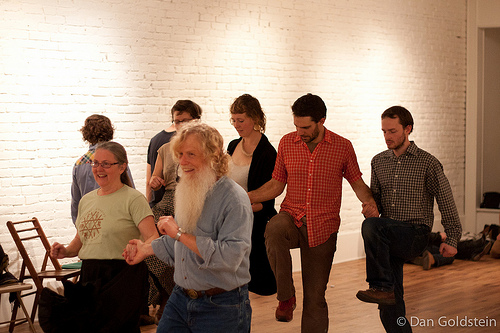
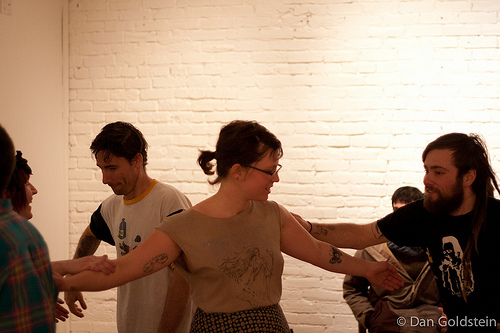
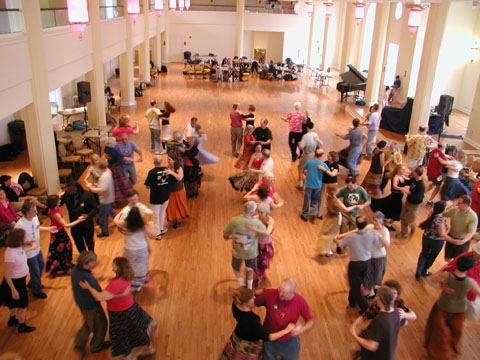
We didn’t quite know what to expect the first time  but were delighted when we arrived to find a room filled with people in their twenties or early thirties playing music and dancing a big circle dance like they dance in Appalachia, with a series of two-couple figures (birdie in the cage, duck for the oyster, right-hand across, four-leaf clover). The young caller, Jesse, was  tall and thin and definitely looked the part of an old-time square dance caller, wearing jeans, a short-sleeved shirt, a vest, cowboy hat, and boots. The women were adorable in their boots and long western-style flounced skirts and tights. All the dancers were quite lively, skipping around the room, making percussive sounds with their feet, and the wooden floor had a nice bounce to it.

We were also happy to see several people we knew and flattered to have been invited, as we were clearly the oldest people there. Jesse called several dances and then the band played a schottische and a waltz. After that, Jim and Laura and Jesse took turns calling dances, mostly squares and an occasional big circle dance. We never had fewer than two squares on the floor and sometimes as many as four. The band kept changing in size and configuration throughout the evening. At one time, there were two fiddles, a guitar, and a mandolin. Later, there were three guitars, one fiddle, an accordian, a mando-yuk, a banjo, a washboard, and a guy playing spoons.

In between squares, we danced various couple dances. Toward the end of the evening, Jesse taught everyone how to dance the Cotton Eye Joe. Then about 10:30, several of the band members began singing songs; one of the dancers laughed and said, “The dance must be over; the guitar players are singing.”

photograph of square dancers

True/False

photo of stage at Missouri Theater with True/False logo projected on screen

Inside the historic Missouri Theater in Columbia, MO

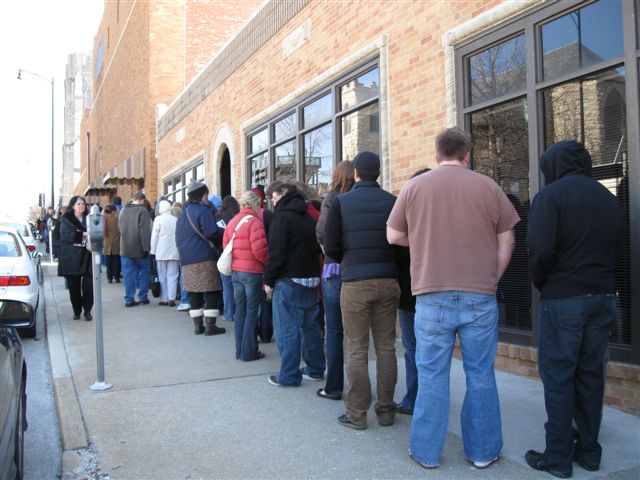
It’s been a week since the eighth annual True/False Film Festival was in town, and I’m still enthralled by the magic of it all. I had been looking forward to the festival for quite some time. We ordered our passes back before Christmas, and a couple weeks before the festival weeknd started, we went online to select the specific movies we wanted to see. Then Tuesday night we stood in a long line outside the box office to pick up our passes and tickets. It is like a big city-wide party, where people from all over the world show up to watch these amazing documentaries that cross the line between true and false but always have strong storylines, interesting characters, beautiful cinematography, and which usually bring attention to people or places or events I haven’t heard of or thought much about before.

Paul and David and others on the film-selection committee do an amazing job selecting films for this festival. Each year, several of the documentaries shown at True/False or Ragtag Cinema end up being nominated for and often winning Oscars, which makes me proud of being from such a progressive town (as though I were personally responsible for this great festival). There is always a fair amount of stress and consternation during the somewhat complicated system of buying passes and reserving tickets, with different pass levels (Gold, Silver, Lux, Simple) having assigned times when they can go online to reserve tickets, but the instructions on the festival website are clear and good humored. This year people who weren’t sure they wanted to invest in an entire weekend of movie going could  purchase a three-movie pass, and there are always a limited number of single tickets available for those who don’t want to buy any kind of pass. Still, for first timers, it can be confusing. The disappointment generally comes when people realize that having a pass does not guarantee that you will get into all the movies you wanted, because people with higher pass levels get to select their movies first, and some of the venues are quite small.  We have probably all experienced the disappointment of seeing the films we carefully selected going “NRT” (no reserve tickets) as we are ordering tickets.

This year we had a Lux pass, and I logged on the very minute we were able to reserve tickets (along with hundreds, if not thousands, of others who had the same Lux passes). I had done my research and had prepared a detailed list of first choices and alternates in case those were sold out, and I clicked through the list quickly and got all my first choices, but then, being the compulsive conscientious person I am, I thought I had better review my selections to make sure I had clicked the right buttons, and immediately one of the first films went “NRT,” so I panicked and hit “submit” before anything else became unavailable. Still, I think that hype is part of the fun. I know that even when I don’t get tickets to the all the films I think I want to see most, I can hardly go wrong. Every one of the films is worth seeing, and there are always other options, even after all the tickets have been reserved.

photo of lines of people waiting to get into movie

Lining up for a film at the Missouri Theater

You can almost guarantee there will be tickets available to the films in the larger venues, such as the Missouri Theater. Also, people reserving tickets often overestimate how many films they can actually take in during one weekend or they forget to leave time  in their schedules for, say, meals, so there is a good possibility there will be seats available even when all the tickets were reserved. To take advantage of that situation, you just need to navigate the infamous “Q” system, which actually works very well. An hour before the film you want to see, you go pick up a number, and then fifteen minutes before the film starts, you stand in the “Q” and wait until they call the numbers and hope you have a low enough number to get one of the remaining seats. If all else fails, some of the better films will be brought back later in the year and shown at the Ragtag Cinemacafe. And some, but not all, will eventually be released on DVD or through Netflix.

This year I deliberately avoided choosing the films most likely to depress me, unlike last year when I saw far too many films about environmental disasters, or previous years, when I saw too many war stories that made me worry even more about my son, who has been deployed to war zones during three of the eight film festivals so far. Still, it’s hard to know from the brief descriptions and the single images what the films will be like; sometimes I just have to trust Paul and David. Over the years, some of the films I thought sounded okay but not great turned out to be among my favorites—like Murder Ball, which was about a paraplegic basketball team that was brutally competitive and broke down all stereotypes about disabled people. When members of the basketball team appeared in the theater after the film, the audience erupted in applause. This year I probably would have skipped the film called Buck, thinking I don’t care that much about horses, except that it’s the one chosen to show in the Missouri Theatre after the Reality Bites reception and thus, almost guaranteed to be a winner.

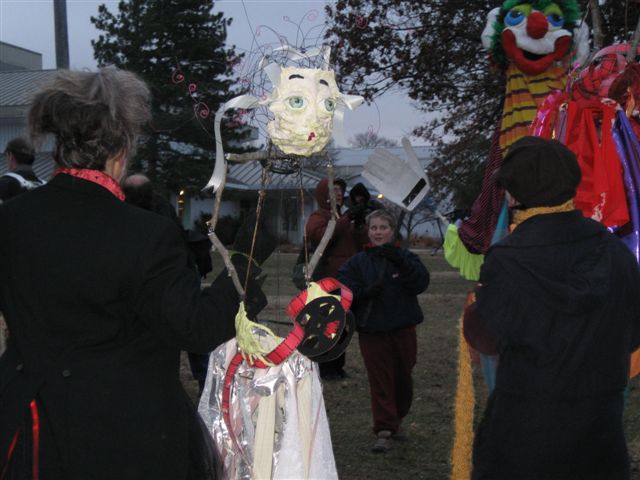
The festival no longer has one big opening film that everybody goes to (with 40,000 people in attendance, the festival has gotten much too big for that), so there will be four or five other films showing at the same time, but by its placement in the schedule, Buck is getting special emphasis, so I definitely want to see what it’s about. Another one I might not have chosen just based on the description is the final film, Life in a Day, which was constructed from thousands of short clips taken all over the world on the same day in July 2010 and then edited into a coherent film. That should be mind boggling and visually stimulating. I also deliberately did not choose any films that start after 10:00 p.m., knowing I would be bleary-eyed and overstimulated by then. Even with a fistful of tickets to thirteen films in four days, I was only able to see about one-fourth of all the films showing during the weekend. In addition to the films, there are always parties and receptions and parades and workshops and all kinds of excitement going on around town that I am also not  able to take in. But I love mingling with all the people downtown, greeting friends who are among the 700+ volunteers helping run the festival, marvelling at the wacky and creative costumes, hearing people talk about their favorite movies, listening to the musicians who are brought in from all over the country to entertain us while we stand in lines or wait for the shows to start, feeling the sheer creative energy that is focused downtown each year at the border between winter and spring, and enjoying the very postmodern experience of watching so many people carrying around cameras to film the festival itself.

Here are the films I saw this year, which you should definitely watch for in theaters near you:

  • Benda Belili
  • The Black Power Mixtape 1967-1975
  • Buck
  • North From Calabria
  • Wisconsin Death Trip
  • Secret Screening White (I can’t tell you the title; we were sworn to secrecy until after the official release)
  • Project Nim
  • Page One: Inside the New York Times
  • The Woman with Five Elephants
  • The Pruitt Igoe Myth
  • Life in a Day

I enjoyed them all, but my favorites were probably Buck, The Woman with Five Elephants, and Page One. From snippets of conversation heard around town, I missed many other excellent films, which I hope to catch at a later date.
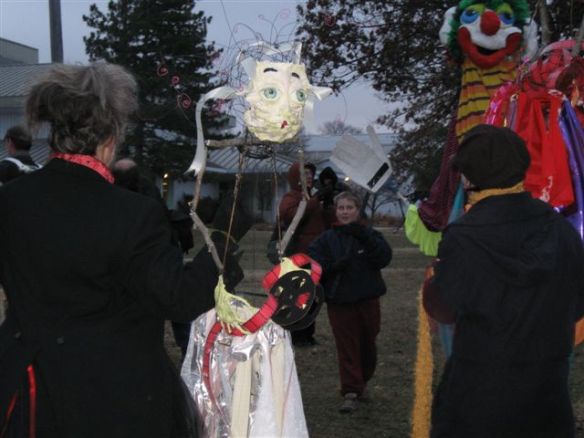
photo of large puppet at parade

Puppets and costumes abound at the March March down Broadway

It’s a Small World After All

This has been one of those “it’s a small world” weeks, during which places I used to not think much about have now become important to me, since my sons have spent time there. On Monday, February 21, Matt’s former sergeant from Alpha Company died in Kandahar, Afghanistan. As platoon leader, Matt had worked closely with this man for over a year, until recently, when Matt was moved to a different position and ultimately to a different company. Although the sergeant was not included on the list of names for care packages (Matt only gave me names of privates and specialists, not officers), I remember Matt talking about what a good man he was. I can only imagine how the soldiers in his platoon must feel. The sergeant was twenty-nine years old; the reports say he died of non-combat causes and that medical investigations are underway. Matt put together a video tribute, which included photos of the platoon in happier days, scenes of the devastatingly beautiful countryside surrounding their outpost, and a soundtrack of the Army band playing Amazing Grace.

On the other side of the world, many of Isaac’s fellow scientists were thought to be in New Zealand when the earthquake hit, while others were stuck back at McMurdo Station in Antarctica, unable to fly into Christchurch to stow their polar gear at the USAP warehouse until the airport could reopen. In the meantime, the sun is setting in Antarctica, winter storms are moving in, and the ice sheet that forms part of the road to the airport at McMurdo is breaking up. Isaac told me there was a link to a chart in googledocs where people could add notes about those who had been confirmed safe. By Saturday, all USAP personnel had been accounted for and the link had been removed, but according to one of Isaac’s team members, three full plane-loads of people were still waiting to leave the ice before winter sets in, her boyfriend among them.

I have been obsessing about the earthquake victims and the polar scientists all week, in between feeling deep sadness for the sergeant’s family and fellow soldiers. As a result, I have not paid as much attention as I should have to all the wars and revolutions going on across the middle east and northern Africa, where many more people are suffering. Not to mention the protests in this country brought on by the attempts to do away with collective bargaining rights in Wisconsin and elsewhere. Since I don’t watch television, I’m not limited to what the mainstream media wants me to know, but that also gives me a skewed perspective, I’m sure, as I seek out only certain kinds of information, depending on my own personal interests and relationships. It is so easy to feel overwhelmed and helpless in the face of such large-scale natural and human-made disasters. And yet, part of me can feel an odd sense of detached interest, as though I were viewing Earth from some distant satellite, able to sense the plates moving beneath the ocean floor, the volcanos spewing forth steam, the waters rising, islands disappearing, the ice caps melting; noting the lines drawn in the air by planes flying from city to city, seeing people massed together in cities all over the globe, wondering what’s going to happen to us all.

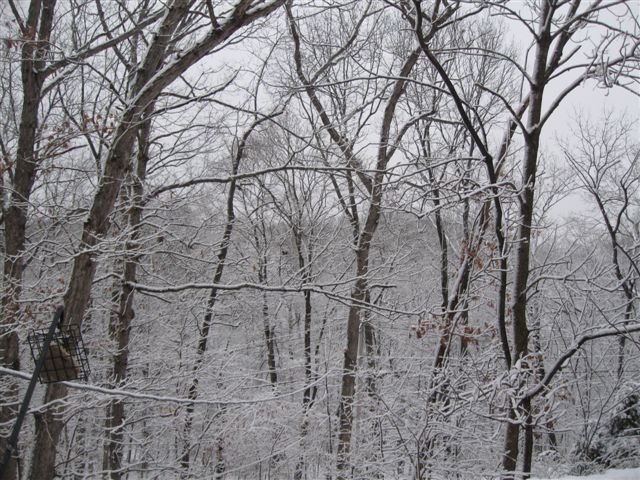
Still it is quiet and peaceful here, with yesterday’s snow melting off the trees and falling softly into the woods, birds visiting the feeders and searching out places to build their nests, daffodils and hyacinths starting to push their way out of the ground, buds swelling on the trees, brocolli seeds sprouting under the lights in the back room. I wish everyone all over the world could enjoy this sense of peace. I know that I am one of the lucky ones. I also know that none of us will get out of this alive.

Squirrels in the attic—not just a figure of speech

The squirrel behind the wall is driving me mad! It sounds as though he has an entire construction crew up there sawing and banging away. Any minute I expect to see him bust through the wall up near the ceiling in living room. Every morning as I sit here writing in my otherwise quiet house, I can hear him chewing away, and I imagine the hole getting bigger and bigger and the walls of my house getting thinner. Soon I expect there will be baby squirrels nestled down in a big pile of woodchips, and then where will it all end? (How many baby squirrels would likely be born at a time, anyway?) Maybe the whole extended squirrel family is inside my house, setting up separate apartments. It sounds that way sometimes. I don’t know if I’d feel better if we had an actual attic or not. My granddady used to just let them move in each winter, and I would hear what I thought was Squirrel Nutkin bowling above the ceiling of my bedroom.

But I keep remembering a show we saw one time—one of those funniest home videos or rescue 911 or some such—which showed how badly things can go. From what I can remember, this attractive single woman kept hearing something up in the attic and figured it was some kind of animal but was afraid to go up there herself, so she called the fire department—you know, the same fire department that rescues kittens from trees, at least on television. I think in real life they just tell you that if the kitten got up the tree by herself, she can get herself down the same way. Anyway, on this particular television show, sure enough the fire department came round and agreed to go up in the attic to take a look. As I recall, the woman was good looking, and the firefighter was one of those take-charge kind of men who prides himself in helping damsels in distress.

So the firefighter sets up a ladder and starts climbing confidently into the attic. When he gets near the top, the squirrel runs at him out of the dark attic, chattering wildly, and startles the man, who then falls backward onto the floor, breaking his leg. So now the woman still has a squirrel in the attic, plus an injured firefighter in her living room. I can’t remember exactly what happened next, but I think more firefighters showed up, determined not to let a squirrel get the best of them and embarrass them all in the process. They put a splint on their buddy’s leg and helped him over to the couch. Eventually, they managed to chase the squirrel out of the attic, who then proceeded to run madly around the living room and through the fire place, setting his tail on fire in the process. By then everyone was in a panic, especially the squirrel, who ran under the couch, which began to smoulder, so the firefighters carried the burning couch out into the yard and sprayed it with water. I can’t remember if the woman thanked them for getting the squirrel out of her attic or not.

Dare to be Square

I’m looking forward to the next square dance at the Hallsville community center on Saturday night. John White, one of my favorite old-time fiddlers, has held these dances the second Saturday of every month for years. The schedule always follows the same format:  old-time open jam at 4:00, carry-in dinner at 6:00, and dance at 7:00.  Everyone is welcome to this family event; there is no smoking and no alcohol. Some people come mostly to play music, including several children that John has been teaching to play fiddle. Others come mostly to dance. Some neither dance nor play music but enjoy socializing. You can expect to find people of all ages at the dance, from babies to great grandparents and everyone in between.

John’s wife, a retired school teacher, always decorates the hall with seasonal items. Last month Betty brought blue tablecloths for all the tables, some with snowflake designs. The table by the door had a two-foot lighted snowman and a painted basket for donations that said “let it snow.” There were two other stuffed snowmen in wool hats and scarves on the food table and bowls of peppermints on each of the tables lining one side of the hall, where people sat to eat their potluck dinner. This time for the carry-in dinner, several people brought soups (potato soup, chicken cacciatore, chicken noodle soup, chili) and salads. There was also a delicious cherry pie and an applie pie. Betty remarked that “you just never know what people will bring,” saying “that’s what make it so fun.” This month I am sure Betty will have the place decked out with pink and red and white Valentines.

We arrived after most people had sat down to eat and some were going through the line for second helpings. A couple of the musicians were still sitting close together in folding chairs at the end of the hall farthest from the kitchen, facing each other, playing tunes while everyone else ate. The hall was packed, even though some of the regulars weren’t there, including several of the home-school families who usually come. There were some newcomers and some people we hadn’t seen for a while, including our friend Musial, whose wife had died suddenly of an aneurism shortly after Christmas. He told me he had decided to come because he knew it would feel good to be with friends, even though he didn’t feel like playing his keyboard.

It seemed at first that there weren’t as many children as usual, and it took a little while after dinner to get the Virginia Reel started, but we still ended up with two lines. During dinner, one of the little girls came up to Jim and asked if they could clog, so before lining people up for the Virginia Reel, he got his clogging students up to practice the routine they learned last year. After the Virginia Reel, Jim asked people to find a partner and form a circle, and he taught them some Appalachian square dance figures (i.e., right hands across, birdie in the cage, duck for the oyster), which was great fun. Then we formed a couple of squares, with Jim calling one and Laura calling the other. At one point in the evening we had three squares going at the same time (two in the main hall and one back by the kitchen); Willie called the third one.

Lately quite a few people in their twenties and thirties have gotten interested in old-time music and square dancing, and they have been telling their friends about it. Last month nearly thirty young people showed up, some of whom had never square danced before. They remind me of the dancers we met in Portland at Dare to Be Square. It’s very interesting to see all these kids showing up with their tattoos and piercings at Hallsville for old-time square dancing—yet another place in our lives where the far left meets the far right and finds they enjoy each other’s company. (Of course, we don’t ever talk about politics or religion at these dances, but it seems to me that if we could all find more such chances to share some common interests, the country would be a whole lot better off.)

By 9:30 there were still lots of people dancing, so Jim did another big Appalachian square and taught some new figures (i.e., basket swing, lady round the gent, four-leaf clover). The young people loved the basket swing, and when four of them met up together, they would really start the basket whirling. After the Appalachian square, Jim joined the circle and led everyone in a spiral as we “wound the ball.” Howard Marshall was lead fiddler most of the evening, and Richard Shewmaker (a young fiddler who has lately been winning quite a few contests) also played a long while. John didn’t play as much as usual, but he called at least one square. At one point, all the “regular” callers (Dave, Jim, and Laura) ended up in the same square together and some of the new dancers formed a second square and were standing around wondering what to do next. John noticed they needed a caller, so he got up and led them through “Right Hand High.”

After the dance ended and we had put away the tables and chairs and most people had left, Jim and John swept and mopped the hall, while Betty carried her decorations out to the car.

Memories of Christmas Country Dance School

Tonight we are bracing ourselves for another winter storm, which, according to the National Weather Service, could bring 1/4 inch of ice and 12 to 18 inches of snow. But I am thinking back to last December, when we attended Christmas Country Dance School in Berea, Kentucky. It’s strange looking back on events, even from a short while ago, how things shift focus over time. When I think back on Christmas School now, what’s left from a week filled with activity from 7:00 each morning until nearly midnight each night are the broad brush strokes as we criss-crossed the campus between the tavern and alumni center and gymnasium and music hall, trudging in snow early in the week, hurrying  in wind and rain a few days later; some days all bundled up in layers against the cold, other days with bare legs and skirts swirling, carrying our shoe bags and crafts back and forth.

photo of small decorative basket

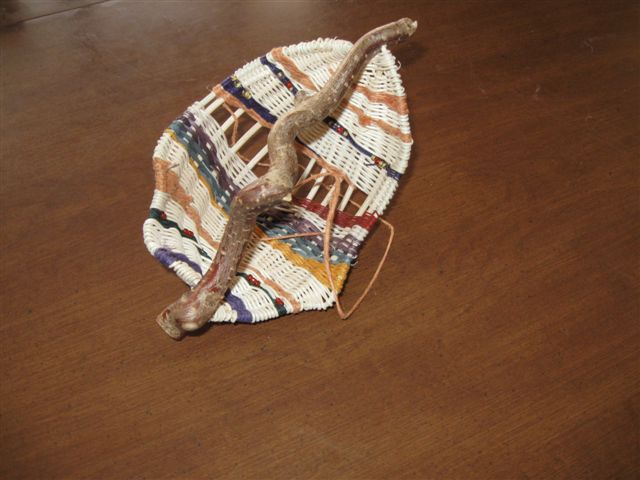
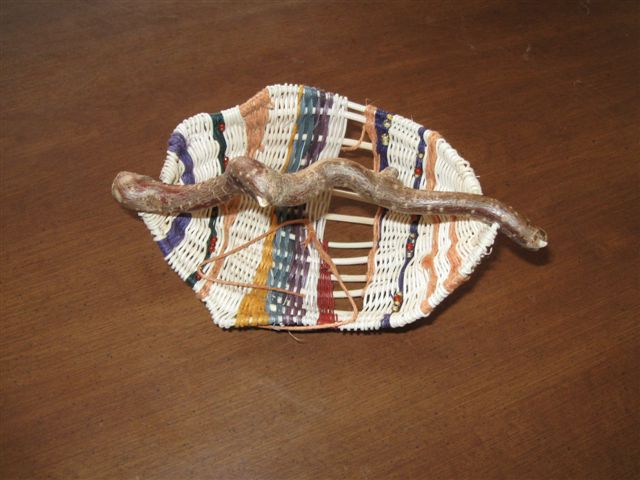
Small decorative basket, with honeysuckle ribs and contorted filbert handle.

We took four classes every day, beginning at 9:00 a.m. I took basket weaving first thing and then Appalachian square dance, while Jim took English country dance and intermediate clogging. We had our choice of about eight different classes every session, including rapper swords, storytelling, shape-note singing, Irish ballads,  and all kinds of dancing. After the last morning class, everyone gathered for morningsong, which included time for announcements. The announcement on Tuesday that brought cheers was, “It is Tuesday morning, and we are not at work.” After morningsong, we headed down the hill and across the street to the cafeteria, then back up the hill to Seabury for afternoon classes. I often skipped the first afternoon class, so I could catch a quick nap, and then joined Jim for Irish set dancing mid-afternoon. After that, we might attend a concert or family dance before dinner, then back up the hill to Seabury for the evening dance from 7:30 to 10:30, after which we all gathered in the parlor for songs and stories.

photo of small decorative basketI can no longer remember the specifics of each day, but I am left with many images as from a dream—my fingers weaving wet pieces of reed through honeysuckle ribs, while the clogging class danced to the fiddle of Al White in the racketball court next door; the feeling of connection that comes from dancing the same dances that people from that region have danced for hundreds of years; the anticipation of a new day as we greeted each other at morning song; the smiling faces I would meet along the contra lines or while walking back and forth across campus; the joyful exhuberance of dancing each evening with three hundred people from all over the world; the warm glow from the candles burning each night at parlor; the sense of peace and happiness that comes from sitting in a room filled with people who are singing together and telling stories night after night, while snow falls outside.

If you’re working on something you can complete in your lifetime, you’re not thinking big enough.

After work we went to an inspiring lecture by Wes Jackson, founder and director of the Land Institute in Salina, Kansas, and author of a new book called Consulting the Genius of the Place: An Ecological Approach to the New Agriculture. The lecture was part of a series on food and society sponsored by the University Museum of Art and Archaeology. Before the lecture we attended a reception in the cast gallery, where a reproduction of Ceres, the Roman goddess of agriculture towered over us as we talked to a couple of young organic farmers about the challenges they face as they work to bring about positive change in the way we grow our food and feed people in our community. We also talked to another young man who works at the St. Francis house, is taking a few courses in biochemistry “for fun,” and planning to start med school in the fall. He recognized us from Hallsville and was telling us what a wonderful time he had at the community square dance last month, his first time ever square dancing. We recognized several other people we knew from the contra dance group and from the local urban farm movement but by then it was time to walk across the street to Middlebush to hear the lecture. I had heard about Wes Jackson and the Land Institute but did not really know much about their work.

postcard illustration

Postcard design by Rose Friedman and Justin Lander based on a quote from Wendell Berry

Wes was a good speaker and quite funny at times but also dead serious about the problems facing agriculture, problems which can not be solved within the current paradigm but will require a huge shift in thinking, a synthesis of differing perspectives, such as could be achieved by merging the perspectives of evolutionary ecology and agriculture. He strongly believes that if we are to feed ourselves and learn to live within our means, we must move away from annual monoculture toward “herbaceous perennial seed-producing polyculture.” At the Land Institute, they are developing perennial grain species that can be grown in diverse arrangements. They have so far developed perennial wheat, wheatgrass, sorghum, sunflowers, and legumes that do not require replanting every year; production yields are promising. As explained in the brochure from the Land Institute, “perennial grain crops provide year-round cover, shield soil from wind, absorb moisture, slow surface runoff. Their year-round extensive root systems manage water and nutrients through weather extremes, while hosting microorganisms and invertebrates critical to healthy soil.” Annual crops, by contrast, require lots of cheap energy to prepare the fields, treat for pesticides, manufacture fertilize. For many of us who live in the flyover states, the short-sightedness of counting on biofuel to save us is painfully obvious. He unfurled a poster that stretched across the front of the lecture hall to show the dense root system of perennial wheat next to the shallow roots of an annual wheat plant. The root system of the perennial wheat was at least three times as long and many times thicker than the roots of the annual wheat.

Wes traced the source of our problems back through 10,000 years of extractive methods of agriculture that have dismantled Earth’s complex ecosystems, reducing biodiversity, depleting soils, polluting waters. He pointed out the problems with an economy that constantly pushes unlimited growth despite the reality of limited resources (which he referred to as petri-dish economics). He identified technological fundamentalism (the kind that claims technology will solve all our problems) as the most dangerous fundamentalism of all and defined hard-headed realists as those who “use a lot less information than what is available.” He mentioned his friend and ally Wendell Berry numerous times during the lecture and laid out their plans for a fifty-year farm bill with five-year farm bills as mileposts along the way. And lest we get discouraged by the enormity of the problems facing us, he pointed out that “if you’re working on something you can complete in your lifetime, you’re not thinking big enough.”

Well past middle age

At forty—even at forty-five—I could, without too much effort, think of myself as “middle aged” and easily imagine that I could live another forty to forty-five years, especially since three of my grandparents and several other relatives lived well into their eighties and remained active and in reasonably good health until the end. But when I turned fifty, I had to admit that it was extremely unlikely that I would live to be a hundred years old and that I had, without knowing the exact moment, passed right on through the midpoint of my life. Still, there was a chance, however slight, that I had used up only half my allotted time.

However, now that I am well into my fifties, the gig is definitely up, and I find myself thinking more and more about how I should spend my precious remaining years. I think about what I want to say to people before I die and wonder whether I have learned anything worth passing on. What do I want to accomplish; what do I still want to find out? My aunt, who is 84 and a voracious reader, told me during a recent visit that if she expected to receive answers to all her questions after she dies, that would be one thing. Otherwise, she’d just as soon stick around awhile and try to figure out a few more things on her own. (I definitely want to stick around awhile myself.)

I recently began reading through my old journals, thinking I should either do something with them or destroy them, and not just leave them unread in a closet to be discovered by others after I’m gone, without at least knowing what they contain. I don’t think I’ve said anything horrible about anyone, and I’ve revealed very few secrets that I know of. But my journals were never meant for public consumption, which makes me wonder whether I should do as my friend Frank did and leave instructions to destroy all my writing, unread, if I die before I have a chance to sort through everything myself. But assuming the journals contain at least some germs of insight or some stories worth telling, what do I want my children and grandchildren to know? What will be my legacy? Who will be the keeper of my stories?

Contra dancing – a swirl of awesomeness

We have been enjoying good crowds at our regular contra dances lately, with quite a few newcomers, including some younger people, which is always nice. I’m not sure how people hear about the dances, although word of mouth is the most likely way. Some say that friends tried for years to convince them to come to a contra dance, but they were always too busy. Then one day they heard an announcement on the radio or read an article in the paper on a night they didn’t have anything else planned, so they finally decided to give it a try. One of our regular dancers has lately been bringing friends from her church. Occasionally, we get college students who grew up in other places where they had contra dancing. Sometimes we get parents in town visiting their college-age students. Sometimes people find us on the Web and stop to dance with us on their way somewhere else.

The dance enthusiasts among us have a hard time understanding how anyone could not enjoy dancing, but the general public is wary at best. They don’t know much, if anything, about contra dancing, although they probably know something about square dancing, and they may express some interest in traditional dancing, even if they don’t think it is for them. Many people seem nervous about dancing in general; they will claim to have “two left feet” or say they “don’t know how to dance” or make some comment that suggests that they believe we will expect them to come in matching Western-style square-dance outfits. Some may have seen clogging exhibitions at heritage festivals and worry that they will have to know some sort of fancy dance steps. Or they may say they can’t come because they don’t have a partner or claim that they personally are interested but their spouse is not. Some will comment that they “used to enjoy square dancing” back in seventh-grade gym class but haven’t tried it since. Or they might ask if contra dancing, which is done in lines, is anything like country line dancing.

If they can be talked into coming at all, they may find that the dancing is more vigorous than they expected or that they get dizzy or that they are uncomfortable being in such close contact with strangers who tend to look them straight in the eye while swinging. I am sure the young people who happen to come to our dances all have the same reaction I had when I took square-dance lessons in high school: What is it with all these old people? Of course, when we’re dancing, we don’t feel old at all; we feel like we did in our twenties when we went to our first contra dance way back during the “folk revival,” when the halls were filled with young people like ourselves, caught up in a swirl of awesomeness as the tune and the dance and the community of dancers all came together perfectly, with a balance and swing.

Don’t worry, Ma, your room is almost ready!

Of course, I’ve turned this into a bigger project than necessary, as usual. To prepare for my mom’s upcoming visit during Thanksgiving week, I could have just changed the sheets and vacuumed the rug in the spare bedroom, put away the mailing supplies for the care packages I’ve been sending to soldiers in Afghanistan, filed the papers that have piled up near the computer desk (or not), and called it good. She would have been perfectly happy with the accommodations. But no. For some reason, I had to make this into the kind of project where I pull all the books off the shelves, empty all the drawers, and drag all the boxes from under the bed and out of the closet in order to “sort things out.”

It started with a small bookshelf just inside the door. I was simply going to remove the books, dust, pull the shelf away from the wall so I could vacuum behind it, and then put the books back where they had been. But as I took a closer look, I noticed that the shelf held few actual books. Mostly, it was loaded with back issues of magazines, old catalogs, manuals for computer programs that probably don’t even work on Windows XP, ring binders of handouts from various workshops I’ve taken over the years (e.g., water quality monitoring, tree keepers), and a notebook of brochures I had picked up when we remodeled our kitchen three years ago. So naturally, I decided I should clear out the clutter this week before my mom arrives.

Well, one thing led to another, and by the time I finished with the bookshelf, I had filled two boxes and one large bag with recycled paper. I filled another box with empty ring binders, and I relocated a collection of books about traditional American dance music to the newly emptied bookshelf. In the process, I went through all the boxes and shelves in the closet.

While digging through the closet, I ran across a box of my old piano music books, which I decided I simply must have out where I can see them—I suppose in case someone stops by the house sometime and asks me to play my old recital pieces again. Not that I have time to play piano, mind you, because I also rediscovered two large bags of wool that I have been meaning to spin into yarn, a table-top loom, and twelve knitted squares that I was planning to sew together into an afghan.  I have a little over a week before mom arrives. I still need to change the sheets on the bed and vacuum the carpet and file those papers that have piled up near the computer.

At least, I didn’t do as my mammaw was known to do when company was coming and decide this would be an absolutely great time to repaint the walls and perhaps replace the carpet, as well (although I must say, the thought did cross my mind). Mom still tells about the year we arrived at mammaw’s house for Christmas to find paint buckets in the guest room and plastic draped over the furniture. Apparently, mammaw had big plans but then abandoned the painting project halfway through, realizing, I suppose, that it was high time to start making pies before company showed up at her doorstep. The remodeling project would have to wait.

I remember that as the year my younger cousin drank turpentine and there was a big discussion about whether to take him to the clinic an hour and a half away or just give him some raw egg. No one actually saw him drink turpentine, but we smelled it on his shirt when he came in to tell someone “that don’t taste good.” But he seemed all right, so no one got too upset. When he later said that the raw egg “don’t taste good, either” and refused to take it, the consensus was that he must not have had that much turpentine, after all, and he would probably be fine. There’s nothing quite like spending time with family for the holidays.