Traditional Family Gathering

On a snowy day in early February, my husband Jim and I took off work to drive four hours west and a little ways north to Rossville, Kansas, for a traditional family gathering. It was snowing and foggy when we left, and the fields were covered with snow the whole drive, but the roads were clear. When we arrived a little before 6:00 at the Potowatamie Nations Community Center just outside of town, the band—Fox on the Run—was already there unloading their instruments. Young girls were carrying evening gowns and fancy dresses out of their cars. Inside, the hall was decorated with blue and silver balls and large sparkly snowflakes hanging by single lines from the ceiling tiles. A food table with a bright blue table cloth was set up along the back wall. To the left of the food table a crucifix was hanging on the wall. The hall was divided in two, with chairs set up on the side nearest the door and a large space for dancing on the other side of the hall. Over the center of the dance hall was a large blue and silver bow draped from the ceiling, with wide ribbons leading out in all directions toward the walls. A small stage was set up on the side of the hall, where the sound man was setting up speakers and talking to the band members. At the far end of the dance hall were several large lighted snowpeople and bare branches that looked like small trees with twinkling white lights.

The organizer, wearing a long dark green gown, welcomed us and asked how the roads were. She told us that a family of ten was driving up from Springfield, Missouri, for the weekend, but another large family from Joplin, Missouri, had decided not to come because of the weather. She explained that the traditional family gathering is held twice a year and always starts with a dance on Friday evening. She expected as many as two hundred people to show up. One year they had a square dance, and the caller brought  records, but she didn’t think the children enjoyed that so much. Another time they hired a contra dance caller and a band, but she thought the caller took too much time teaching and not enough time dancing. She asked Jim about the kinds of dances he planned to call. She wondered if the band could play some swing at some point during the evening, because some of the kids liked swing dancing.

While the band did their sound check, a young boy about six years old, wearing a suit and tie, walked up to a little girl about five, who was wearing a fancy red dress, and held his arms out to her in ballroom position. She placed her left hand on his shoulder and he placed his right hand on her back, and they began to polka around the hall. I whispered to Jim that I hoped he had some harder dances picked out, because it looked like this crowd knew what they were doing. Three girls about ten years old, all wearing long dresses, put their arms around each other’s shoulders and skipped around the hall in time to the music. By that time, more people were coming in, and the level of conversation increased in the hall, as people greeted one another. All the men and boys were wearing suits or nice slacks and ties. A few had on tuxedos. The girls were wearing somewhat old-fashioned formals and evening gowns and had their hair up; a few had ringlets. Only a handful of the girls had short hair. One of the women, a kindergarten teacher, later commented on how proud she was of the girls for having found such modest dresses. “That’s not easy these days,” she said, “with all the spaghetti straps and the plunging necklines.” Several of the dresses looked hand made. There were lots of children and babies and many teenagers, but few old people.

Shortly after 6:30, the band finished with their sound check, and Jim invited the dancers to “find a partner and form a big circle” for the first dance. The dancers were somewhat subdued at first, as though they weren’t convinced this was going to be much fun and were reluctant to leave the conversations on the brightly lit side of the hall, but as the evening went on, more dancers joined in each time, until by the end of the evening, over one hundred people of all ages were dancing together, clapping their hands, skipping around during the longways sets, whooping when the squares went “into the middle and back.” Jim called several longways sets, a couple circle dances, an English country dance, and a couple of old-time squares. During breaks, the band played swing dances and waltzes. One young teen requested “Cotton Eyed Joe.” Jim ended the evening with the Virginia Reel, as he often does when he calls for home-school groups or church groups or reenactment dances. For some reason, this dance is always more popular than any of the other similar reels.

After he completed the walk-through but before the band started playing, the young people began clapping a very fast rhythm. Although the band had not intended to play the tune that fast, they decided to go with it, and Jim started the dancers off with “long lines forward and back” and continued calling through the right-hand turns, the left-hand turns, the do-si-dos, until he got to everyone’s favorite part, where the top couple “reels the set,” and the rest of the dancers clap their hands as the couple works their way down the set and then “sashays” back to the top. The top girl then leads the line of girls around the outside and back to the bottom of the set, while the top boy leads the line of boys in the opposite direction. At the bottom of the set, the lead couple forms an arch and the other couples then duck through the arch and come back to the top of the hall, where the whole thing begins again with a new top couple. There were six or seven sets of dancers at that time; each set had ten or twelve couples; one set had all elementary-age children, others had all teenagers, some had a mix, a few sets included adults.

After a few times through the dance, the sets usually get off from each other, depending on how many couples are dancing, how fast the top couples are able to reel the set, how quickly the lines skip down to the bottom and back up through the arch. Usually Jim will stop calling at that point, and the dancers will continue on their own until everyone has had a chance to reel the set at least once, which often takes twenty minutes or more, depending on how many dancers are in each set. Several of the sets were flying through the dance (the set I was watching had about eight or ten very tall and handsome young men, probably all brothers, who were doing high kicks during portions of the dance and “high fives” as they passed the other men in the line), and the energy in the room was contagious. After twenty minutes or so, when the music stopped and the dance ended, everyone applauded loud and long. Jim thanked the band and quoted Mark Twain who once said that “any fiddler who can fiddle all through one of those Virginia Reels without losing his grip can be counted on in any situation.”
Jimmy Santiago Baca

The first book on my shelf now (after alphabetizing and straightening) is a small volume of poetry by Jimmy Santiago Baca, Martin & Meditations on the South Valley, with an introduction by Denise Levertov, published in 1987 by New Directions Press. The cover, based on a black-and-white photo by Migel Gandert, shows a close-up of a man’s back with three large tattooes etched into his skin.

The central tattoo, which extends along the man’s spine from just below his shoulder blades to his waist, is of Jesus dressed in long robes, with a disc-shaped halo framing the back of his head; he is holding a cross, looking off to one side. A second Jesus—this one dark-skinned with full beard and long straight hair, wearing a crown of thorns pushed down low on his forehead—appears on the man’s left shoulder. A third tattoo, on the right shoulder, is covered by a gold sticker announcing this book as the 1988 winner of the American Book Award.

Two other tattoos, on the backs of this man’s arms, are somewhat difficult to make out. The one on his left arm shows what might be a long-haired worker heading down a path, wearing t-shirt and loose pants, with a handkerchief sticking out of his right back hip pocket, but I can’t tell whether the man is wearing a hat or a halo tipped to one side. The tattoo on the right arm shows a bare-breasted woman wearing tight leggings and high heels and carrying something like a knife. There is a wide strap across her shoulders, between her breasts, and a large circular something on her back (a shield, perhaps).

I don’t remember for sure, but I suspect that I acquired this book while in graduate school studying creative writing under Garrett Hongo. He was always after us to find our own voices, rediscover the places we had come from, listen to the language and the rhythms of our people, tell our own stories—as Baca has surely done in his book. Hongo, of Japanese-Hawaiian descent, could be abrasive within a department that at the time consisted mostly of white men deeply entrenched in the Western canon, but I appreciate the way he encouraged us to seek the myth within the reality of our day-to-day lives.

As I read the two long narrative poems in this book, I am struck by Baca’s powerful voice, his startling images, his syntax and language so different from my own, his moving portraits of the people from his barrio. Denise Levertov in her introduction to this volume calls his work a “Hero’s Tale.” And it is epic in scope. While a distant voice reminds me that what seems exotic to me may seem ordinary to the people living through it and points out that my own life has been filled with experiences worth transforming to poetry, the ungracious, peevish part of me wonders if I could have written more or better if I had been abandoned by my parents at a young age, had been placed in an orphanage, had struggled for survival and ended up on the streets, had taught myself to read and write while in prison.

I do a quick Google search and learn that Baca is two years younger than I and has written ten books since this one was published: seven books of poems, a memoir, a book of stories and essays, a play; and that he regularly teaches writing workshops to Chicano youth. And what have I been doing all those years?

Button Boxes

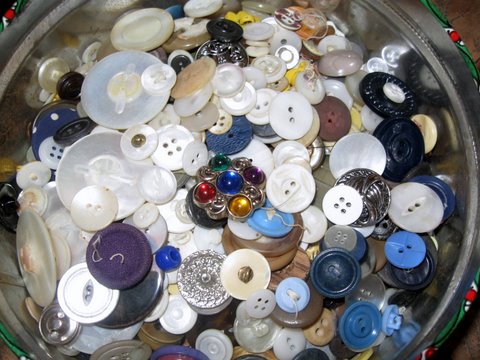
This week I have been digging through my button boxes, trying to find six matching buttons for a sweater vest I knit earlier this winter. What is it about buttons? These are not particularly fine buttons, but I find them interesting. I like the way they feel in my hands, the way the small ones slip through my fingers, the light sound they make when they tumble over each other into the metal box. I like to think of the people whose hands have touched these buttons over the years, as they sewed them onto a garment or pushed them through the button holes to fasten their shirts or jackets.

I don’t remember where I got this particular button box, but I have vague happy memories of playing with such a button box when I was a child. Do people even keep button boxes any more? Used to be women would snip the buttons off old clothes to re-use on another garment and would save any good pieces of fabric to make scrap quilts. At least that’s how I imagine it was, although my maternal grandmother didn’t sew at all and my paternal grandmother always bought new fabric for her quilts. So where did this particular button box come from? I only recognize a few of the buttons from my own sewing projects. Perhaps my mother-in-law, who sewed for other women and always had extra fabric and notions lying around, gave it to me the year I decided to make Christmas stockings for my children. Perhaps I bought some of the pearl buttons at the antique mall for that project.

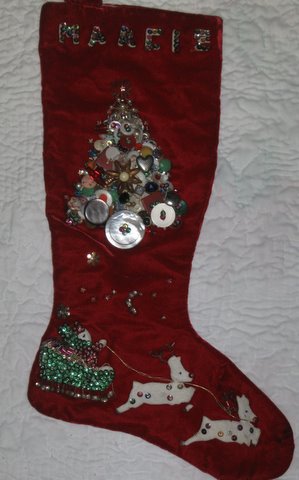
When I was eight, my aunt gave me and my brother beautiful red velvet Christmas stockings, lined with white satin. On the front of each was a large Christmas tree made entirely of antique buttons and sequins. When my brother and I posed in our pajamas with those stockings, holding them out for our parents to admire, beaming at the thought of all the wonderful gifts and candies that Santa would fill them with, they were so long they nearly reached the floor. We used to spend hours examining the buttons on our stockings, turning them this way and that in the colored lights from the Christmas tree, excited when we found we had buttons that matched, even more excited when we found buttons that the other didn’t have, each of us convinced that our stocking was the most beautiful, our buttons the most special.

The buttons in my button box are not nearly as fine. Mostly the box is filled with ordinary plastic buttons, the kind that would have been on dress shirts or wool coats or women’s jackets in the nineteen fifties. A few have embossed floral or geometric designs that I like. There are a couple metal buttons, one large button covered with blue and white polka-dot fabric, buttons shaped like leaves or bees or tiny handprints, many buttons made of pearl, a few buttons with rhinestones. There are no painted buttons or glass buttons. A quick web search tells me that I’m not the only one with a fascination for buttons and that button collecting gained popularity in the 1930s as a hobby that anyone could afford. The National Button Society was formed in 1938 and today has 3,000 members on four continents. There are button shows, including one this spring not too far from where I live. There are competitions and awards, magazines and newsletters. I discover that buttons are classified according to age, use, size, material, and design; and that age and use are specified by division. I learn that there is an online discussion group dedicated to button collecting.

I learn that I don’t know a thing about buttons, that the buttons that I cavalierly grouped together as all made of “plastic” could in fact be made of celluloid, cellulose acetate, casein, phenolic, amino, polyester, acrylic resins, polystyrene, nylon, polyclays, or ABS polymers (none of which mean anything to me). There are ways to test for these, of course, and if I cared enough, I could order a “Synthetic Polymers Handbook” that will give me “more information to aid in my identification efforts and general plastics education.” There are whole booklets filled with rules about how (or whether) to clean antique or vintage buttons, how to assemble a tray or mount your buttons, how to enter  button collections in competitions. Nearly 9,000 sellers are offering buttons for sale today on Ebay. Some buttons are listed individually; some by the pound. I am frankly overwhelmed. Now, instead of bringing me pleasure, my small box of buttons makes me anxious.