Unknown's avatar

About Marcie

Writer and Editor

First Dance

I wish I could regain the excitement of the first time I ever took part in a community dance. Although I still enjoy dancing, it’s not quite the same as that first mountain square dance I attended at Natural Bridge State Park when I was fourteen. I had taken square dance lessons that year at a club called the Wheelers and Dealers, in Lexington, Kentucky, which I thought was fun, even though most of the dancers were old (about the age I am now, as a matter of fact), and they wore matching outfits that seemed sort of ridiculous to me—cowboy shirts with snaps and bolo ties for the men, big puffy crinolines and pantaloons for the women.

I don’t remember whose idea it was for me to take square dance lessons, but I remember going with my friend Marjorie and an older couple she knew, probably from church. My partner for the lessons was a sixteen-year-old boy from school named Tommy. I was not allowed to go on car dates at the time, but I was allowed to ride to Lexington with Tommy to square dance lessons. I don’t remember much about the lessons themselves, although the whole series lasted about sixteen weeks, and we probably attended a regular club dance or two after we graduated. What I do remember is the first mountain square dance I attended after we finished the series of lessons.

The mountain square dancing was completely different from the club dancing. I don’t know if this was a regular weekly dance or some kind of folk festival we attended, but we danced outside under the stars at Natural Bridge State Park, and the first thing I noticed was that instead of forming squares of eight dancers each, we formed a big circle to start. The next thing I noticed was that most of the dancers were young. Some of the boys were wearing overalls and work boots. The girls were wearing simple cotton dresses.

The figures were simple—no need for lessons—and the fiddle music was very fast.  Although I had never danced this kind of formation before, it felt like home. I had no trouble with many of the moves, which were similar to moves in the Western squares, but I did learn that there were lots of ways to do a “do-si-do.” There were other calls I had never heard before, such as “chase that rabbit, chase that squirrel, chase that pretty girl round the world” and figures such as “birdie in the cage,” but the other dancers took us by the hand and led us exuberantly through the dance.

Many of the dancers did a jig step as they went through the figures, while others loped along at a pretty good clip. I did not know at the time that we were doing “Kentucky running sets.” I still don’t know whether the term refers to the fast running step the dancers take as they go through the figures or to the way the dancers “run” the figures one after the other before moving on to another couple.

Each figure is done with two couples together. For example, my partner and I would take hands with another couple, and the caller might tell us to “circle to the left, then back to the right” or “star right, star left” or  he might say, “you swing mine and I’ll swing yours; give me back mine I’ll give you back yours.” If he called “birdie in the cage,” one of the women would jump into the middle of the circle, while her partner and the other couple would keep holding hands while circling around her. Then when the caller said, “birdie hop out and crow jump in,” her partner would take her place, and she would rejoin the circle around him.

At the end of each figure, partners would take hands and move along to the next couple, the couples on the outside of the circle moving in one direction, the couples on the inside of the circle moving in the opposite direction. Then the caller would start another figure, such as “dig for the oyster, dive for the clam” or “round one couple take a little peak” or “wave the ocean, wave the sea, wave that pretty girl back to me.” By the end of the evening, we had danced with all the other couples.

The whole evening was magical, and the music and dancing continued until long after dark, while campfires throughout the park glowed in the distance. When we finally stopped dancing, the breeze felt cool on our skin, and the dreamlike memory of the whirling circle made it seem as though I had stepped into a fairy circle in the middle of the woods on a summer night. Although it took me many years to find a community where I could dance regularly and a partner who enjoyed it as much as I did, after that first mountain square dance, I was hooked.
Searching for Meaning

This little project I have given myself—to look through all the compartments I have set up over the years (the shelves, the drawers, the boxes, the bags, the baskets) in an effort to figure out what I value, what I would try to save in a fire, what I want to destroy before I die, what I would grieve if it were forever lost to me, what I want to pass on to my descendants—has shown me how easily I allow myself to be distracted in my search for meaning and purpose. I have always admired those who single-mindedly follow their passion, those who believe without doubt in their calling, those who willingly sacrifice things of value for an ideal, a belief, or end.

I have never been like that; I  never wanted to choose a single path, nor did I feel that I was specially “called” for anything, although I do recognize that I have some gifts, and I have at times felt guilty during certain Sunday school lessons about “hiding one’s talents beneath a bushel.”  Even when I try to focus on what is before me, I am continually amazed at how quickly thoughts and insights and observations are gone before I can put them into words and how the act of trying to capture them changes the experience itself. I find myself continually noticing things that I want to explore “later, when I have more time,” but then later, something else has caught my attention or I have forgotten what it was I meant to think about. Occasionally, I may pick up a theme again as in a complicated fugue, but many things have been lost to memory over the years.

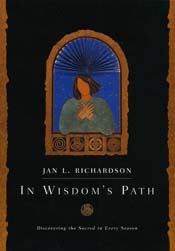
I think I know what I will find on my third shelf: books about spirituality and the unseen aspects of life, books that explore the mystery of why we are here, books about lucid dreaming and the dreams of women, about Earth religions and Celtic mythology, faery tales, books about mindfulness, books about the goddesses in every woman and the gods in every man, books about feng shui, books that could send me to prison in repressive governments. And I do find those books I was expecting, but in addition, I find a beautifully illustrated book I had forgotten I owned, given to me by my brother and his wife, written by their friend and former pastor, Jan Richardson, the woman who performed the ceremony at my niece’s wedding.

The book is called In Wisdom’s Path, and I have been reading it with great pleasure this past week, every morning as I drink my tea, before I get ready to face the day. The title refers to the Wisdom of God, portrayed in Proverbs and in apocryphal books as a woman who danced with God at creation and dwelled with God from the beginning of time. I like that. She is depicted as a woman “who had an active hand in history, who cries out for justice, who bids us to feast at her table, who calls out to us to follow her path.” I want to go with her. Jan’s book consists of strikingly beautiful paper collages, brief personal essays, scriptures, and poems depicting her ongoing search for god and the spiritual pilgrimage she made after leaving her position as associate pastor of a large Methodist congregation in Orlando.

The book follows the Christian liturgical year, beginning with “The Cave of the Heart” (Advent), continuing through “Showings and Encounters” (Epiphany), “Art from the Dark” (Lent), and  “Walking Out of the Wound” (Easter). The last section is on “Ordinary Time.” The author wrote this book while serving as artist-in-residence at San Pedro Center for Art and Contemplation, where she lived in a small cabin in the woods near a lake. In this beautiful book, she describes her spiritual pilgrimage and her encounters with God “in some of her forms and in some of his guises.” I feel blessed after having glimpsed a little of what she saw along the way.

Printing Press

The most extraordinary thing I own (and the most difficult to get rid of) is an antique printing press—or what used to be a printing press. Now it is a 2000-pound cast-iron anchor to my past and to this place. We got it from a bachelor farmer named Jim Booth, who used to live in Princeton, Missouri, and who, in addition to farming and caring for his elderly mother, also ran a business he called, logically enough, “Jim’s locksmith, print shop, and shoe repair.” (I wonder how he classified it for purposes of accounting or income tax preparation.)

We first met Jim through his mother, “Maw-maw,” whom we got to know when my ex-husband, Mike, was putting together an alumnae art show for Stephens College, where he was then teaching graphic design. She had responded to an invitation to tell how she had used her art since graduation by saying that she “hadn’t done much with her art, other than give occasional chalk talks around the county” but that her son, George, was doing right well as a cartoonist in New York. We could not believe our luck. Could this be the same George Booth whose cartoons we read each week in the New Yorker?

Well, one thing led to another, as they tend to do, and Maw-maw agreed to make the four-hour trip to Columbia to participate in the alumnae art show in the spring, and she said she thought she could convince George to come along to do an “ambidextrous chalk talk” with her. Maw-maw was well into her eighties and didn’t travel easily, so her son Jim fixed up a “camper” with a place for Maw-maw’s wheelchair and easel and pads of drawing paper and buckets of colored chalk, as well as a platform where she could stretch out if she got tired on the trip, and one day they all pulled in to our driveway.

It was the oddest thing to meet characters we had seen for many years in New Yorker cartoons. Maw-Maw was obviously the inspiration for George’s drawings of Mrs. Ritterhouse, the fiddle-playing old woman who used to sit on her front porch and shoot down crop-duster planes. And looking at Jim’s home-made camper, I could easily imagine that their farmhouse up in Princeton might have bare lightbulbs hanging over the kitchen table, with numerous extension cords running from the fixture to every appliance in the place, and dogs and cats lounging about the house and yard—just as in George’s cartoons.

George did indeed do an ambidextrous chalk talk with his mother to a small but somewhat bewildered audience in Windsor Lounge. They stood together at the easel, telling down-home stories and illustrating them with funny drawings, Maw-maw holding the chalk with her right hand and George  with his left. It turns out that she had done something with her art since graduation, after all, as she had been publishing a cartoon a week in the Princeton paper for the past thirty years. Before that she was a schoolteacher, and her husband was a principal. She was very happy to be back at her alma mater and reminisced about how she had met her husband at the University a couple blocks away. As they were packing up the camper to return home, Maw-maw told us again what a good time she had and invited us to come visit them sometime. Of course, having just met these people who looked as though they had walked straight out of cartoons we loved, we had to go see the place they called home. That’s when we learned about Jim’s locksmith, print shop, and shoe repair.

The print shop especially caught our imagination. I had been interested in letterpress printing and book arts for many years, since taking a workshop in library school, and Mike, as a graphic designer, was interested in woodblock prints. Of course, Jim’s printing press was nothing like I had worked with before or was interested in owning. For one thing, it had an electric motor hooked up to it and an enormous flywheel that frightened me. The trays of type that Jim used were all mixed up, different sizes and fonts all jumbled together, but they served his purpose, apparently, which was to print flyers for tractor pulls and farm auctions and old thresher reunions. Possibly we mentioned sometime during the visit that we had “always wanted to have a printing press.”

We only went for the one visit and we never met George again, although Mike continued to correspond with him for a while; the year our younger son was born, George sent him a stuffed animal (an adorable pig) and sent our older son one of his books, It’s Not My Turn to Look for Grandma, which was destined to become a favorite. During those years, Jim would occasionally stop by the house when he came down to Columbia for medical appointments or visits to the VA. Sometimes he would spend the night in his motorhome, which he pulled up out front and plugged into our house. He began talking about having to sell the farm when his mother died and wondering what he was going to do after that.

One day he arrived unannounced, hauling the printing press on a trailer, and then proceeded to hook up a winch to his old car and basically “ride” the press down the concrete steps on skids into our basement. It was amazing to watch, and I wish now that I had filmed the process. He then unloaded typecases, trays of jumbled and broken type of all sizes, bottles of ink, ink rollers, composing sticks, quoins and keys, and various other supplies and equipment. He assured us that the press worked fine, but I had no intention of ever turning it on around my two-year-old son, and sending that giant wheel flying. Fortunately, within days of it being in our house, our dog chewed through the band, and I knew we would never get the thing repaired and running. Years later, Mike and I divorced, and he moved out, but the broken printing press remains.

Downsizing

The story was that my grandmother sold the cabin on the lake—furnishings and all—while my grandaddy was out fishing, and then they retired to Boca Raton, Florida, where they bought all new everything, including dishes, towels, and linens. Possibly that was even true.

They had already moved out of the large two-story house in Georgetown, Kentucky, where they had lived for more than twenty years while teaching at the college. I don’t know what happened to everything they once owned, but I know my mother has a few family items—a cherry press, a Seth Thomas clock, and a rocking chair with arms carved into swans that used to be in the formal living room. My brother may have another rocker that was in their master bedroom.

I used to own the Starr piano that was in my grandparents’ dining room, until I traded it in when I bought a new Baldwin the summer after I graduated from college. I also have a few items that somehow came down to me over the years, although I can’t quite remember how I ended up with them:

  • a small writing desk
  • a few sheets of piano music from the nineteen-fifties that belonged to my mother when she was a teenager
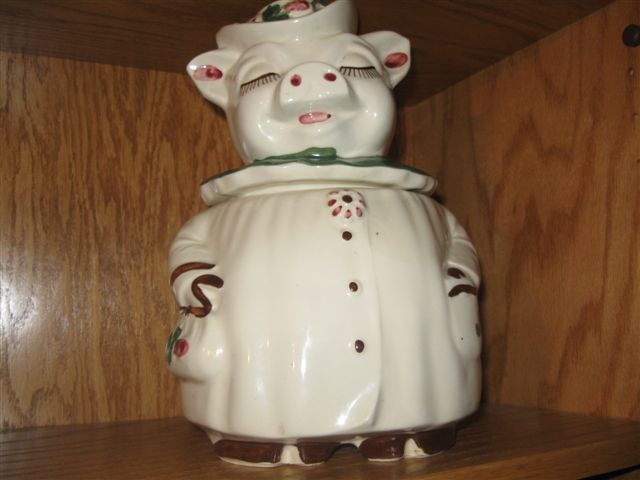
  • a ceramic pig that held sugar cookies in the large pantry off the kitchen
  • a set of Noritake china with pale pink and yellow roses and an ornately patterned rim
  • a small wicker rocker that belonged to grandmother when she was a girl

I also have a copy of my grandparents’ college yearbook from 1920, which they gave me when I graduated from their alma mater fifty-five years later, and a book called Boys and Girls at School, which grandaddy used to teach my mother how to read when she was only four.

I used to think my grandparents were crazy for getting rid of everything the way they did, but now I think they were very wise. Much of what they owned was not particularly valuable, but I have seen families break up over less. I have also seen people hold onto things well past the time when they still bring anyone pleasure, perhaps because they think the objects might be worth something someday, or the children might want them, or because they paid “good money” for them and it would be wasteful to get rid of something that is “still good.” These days there is also the guilt of adding one more thing to the landfills. I can definitely relate to all those reasons, but I’m trying to learn to let go. After all, every one of us will have to walk away from everything some day, whether we are ready or not.

For someone who claims not to care about material things, I sure have accumulated a lot of stuff over the years. As I look around my house at the cluttered tabletops, the crowded bookshelves, the overstuffed closets, I wonder what it would be like to leave it all and not look back.  Mostly I think it would bring a wonderful sense of freedom, although I suspect I would soon discover that there are, in fact, things I can’t live without, things I would miss terribly. Over the years I have often played this little game with myself in which I imagine coming home and finding that my house has burned to the ground or been blown away in a tornado. In these scenes, I am always grateful that no one was hurt, but immediately I begin to alternate between feelings of immense relief that I am no longer burdened with possessions and deep-seated grief over all those things that can’t be replaced.

Dolls

I  began buying porcelain dolls after my daughter Megan was stillborn twenty-seven years ago. The first was a red-headed doll named “Megan,” designed by Jane Zidjunas.  Then “Jennifer,” a blond doll by the same artist, followed by  “Nicholas the Winter Baby,” designed by Joan Ibarolle, and  “Amelia,” by Virginia Turner.

Most of the dolls are now packed away in the hall closet in their original boxes, with their “certificates of authenticity,” but the dolls Megan and Jennifer are standing about in the sewing room downstairs. I used to make clothes for them and dress them up for Christmas, but these days they wear their pastel overalls and flowered blouses and saddle oxfords year round. Occasionally I dust off their faces with a soft cloth and smooth their hair.

I did not buy these dolls because I thought they would be worth something someday; I bought them because I liked their looks, and they reminded me of things I had lost. I no longer have any of my childhood dolls, although I do have a doll that belonged to my grandmother’s sister Mary, who was born sometime around 1885 and died of typhoid when she was 18. I wonder if my grandmother, who was only five when her sister died, was allowed to play with this doll. Perhaps she was the one who broke the head and feet by accident one day.

The dolls sometimes remind me of an old woman I knew in Frankfort, Kentucky, a retired art teacher who volunteered at the library where I worked, recording books for the blind. She was one of those strong-willed southern ladies who donated thousands of hours to local charities each year and formed the backbone of society in those days. She had no children of her own but taught several generations of schoolchildren during her career.

She had been widowed at a young age but still lived in the house where she grew up, a large two-story frame house south of the river. Every Monday at four in the afternoon, she opened her house to friends and acquaintances who were welcome to drop by for tea and cake. She herself was diabetic and could no longer eat sweets but said that when she died, she was planning to eat her way around heaven—as soon as she kissed her husband hello.

One spring day about thirty years ago, my coworker Betsy and I decided to take off work early and go to Mrs. Frymyre’s house for tea.  We explained to our supervisor that she was one of our most faithful volunteers and we ought to show our respect by accepting her invitation to tea, but really, we were just curious to see inside her house, thinking that an artist’s’ home would be filled with beautiful objects and bright bits of clutter that might end up in collages or inspire paintings someday.

She greeted us at the door wearing a simple dress and a brightly colored silk scarf fastened near one shoulder with a large brooch. When we stepped into her living room, we were amazed to see hundreds of dolls of all sizes, sitting in little wicker chairs or lying in carriages or standing in their ball gowns under bell jars on tables. There were dolls seated on the steps leading upstairs; in the dining room were more dolls everywhere we looked.

And on the dining room table was a large tree branch painted with white enamel, with hundreds of elaborately decorated Easter eggs and ornaments hanging from the smaller branches and twigs.  Beneath the egg tree were dozens of Easter bunnies, pastel chicks, sugar eggs with dioramas inside, hand-painted ceramic cases shaped like eggs, bejeweled eggs on little stands. I felt like I was ten years old again, in the art room at my elementary school, dazzled by all the bright colors and beautiful shapes, inspired to create  something amazing.

Starting Over

I wonder how many posts to blogs begin with an apology for not having written sooner. Of course, I’ve got the usual excuses—I’ve been busy—but who isn’t busy these days? (I like to say that if you don’t have attention deficit disorder these days, you should try to develop it as a necessary job skill.) Keeping busy has become a lifestyle for most of us, what with our day jobs and our avocations, our volunteer committees, our so-called leisure activities, not to mention all the time it takes just to keep up—going to the grocery store, preparing meals and cleaning up after, washing and folding laundry, dusting and vacuuming, scrubbing the sinks, bathing and brushing our teeth, phoning our family, checking in on Facebook, reading the newspaper, sorting the recyclables. Still, I should have more time than most to do what I say I want to do, which is to write. We no longer have children at home, the grandchildren live far away, our last pet died a year ago, I’m not trying to work on an advanced degree in my “spare time,” and we don’t own a television. But I do like my sleep, and the hours are sadly limited.

By the time I get home from a full day of staring at a computer monitor editing other people’s writing, the last thing I want to do is sit at the computer and write. For one thing, the editor in me is all too eager to say, “No good! Delete that last sentence. Don’t say that! That’s boring!” For another, there are so many other things I also want to do. For example, I’d like to have a glass of wine and finish that book I’ve been reading about Antarctica. I’d like to plant my spring garden. I’d like to go for a walk through the woods or play music or dance with my husband. I’d like to work on the sweater I’ve been knitting. I’d like to knit baby hats for my coworker’s triplets and a poncho for my granddaughter. I’d like to get out my watercolors and paint. I’d like to reupholster the wing-backed chair in the living room.  I’d like to go on one of those eco-tours to help save baby sea turtles or repair fences out west somewhere. I’d like to learn Chinese.

Lately I have found myself doing the math in my head to try to calculate how much time I likely have left, how much time I’ve wasted so far. It is obvious that I am well past middle aged, unless I expect to live to be 110. I hope I have at least a good thirty years remaining, but of course, there is no way to know. Still, my genetics seem fairly sound, and I try to take care of myself. But there are always accidents to worry about and new diseases we haven’t yet discovered. Occasionally, I am caught off balance by a line from a poem by W. S. Merwin that comes back to me at odd moments when I am least expecting it and reminds me that “Every year without knowing it, I have passed the anniversary of my death.” What a thought! When I was young, I used to think I didn’t know enough about life to write with authority, and so I missed many opportunities to write about my experiences at the time. All these years later, I still feel as though I am not wise enough or experienced enough, but I’m beginning to think that there are a few things I’d like my children and grandchildren to know, which they may not have an opportunity to learn if I don’t try to pass them on in the years I have left.

Susanne E. Berger

The second book on my shelf (alphabetically speaking) is a book of poems called These Rooms by Suzanne E. Berger. I have no idea where this book came from. I don’t remember reading it before, and I have no particular associations with it. It was published by Penmaen Press in 1979, and a note on the back cover says that the first letterpress edition went out of print in six months. Of course, that doesn’t tell me much. I know that a letterpress edition could have been a very small run, 25 copies even, just enough to give her family and closest friends a copy. The back  is filled with accolades from  the right people and places: Maxine Kumin, Linda Pastan, Boston Globe, Ms, Publishers Weekly, Library Journal, who praise the author’s “lyric intensity and fresh vision,” her “vivid and intense” imagery, her “mesmerizing lucidity.”  I fear I must be missing something (perhaps I am not a poet after all), because most of the poems in this volume feel to me like tight-fisted secrets, although I am unable to say quite why.

After reading this book straight through quickly, I feel a vague sense of loss, as though I have just wakened from a dream of someone dying, but I don’t know who died or how they were related to me. (After reading Baca’s book, by contrast, I feel that I know exactly what he has lost and how he felt about it and what he did after.)  I don’t get that same sense of shared experience from Berger’s work,  but there were two poems that reached out and grabbed me. One called “Desert” seems to be about a miscarriage. It begins with the narrator standing at the window, touching her belly,  “as quiet as a desert, as smooth and flowerless” and ends with an image of  the narrator imagining “a small mouthful of Kyrie there singing on in the dark” and tracing “it was nothing, nothing on the mute-faced glass.”

The other is called “New Pig Keeper,” which describes “a dreamless pig, a throne of flesh….the balding queen of fat.”  Although I love the descriptions of the pig in all her physicality, I don’t quite understand the pig keeper. Something about appetites, I suppose, and controlling them or being devoured by them? One of the most powerful stanzas in the poem describes the pig’s “freckled mouth…a universe of buds and warts, slop-tasters each and all.”

A quick search on the Internet lets me know that this was probably Suzanne’s first book, so I should not be so harsh. There is a power in her words, even when I can’t be sure where it’s coming from.  She published another book, Legacies, in 1984, and then, one day in 1985, as she leaned over to pick up her toddler, she felt a tear deep within the flesh across her back, which left her unable to stand or walk or sit, much less canoe or ice skate, as she had done before. The injury ultimately affected her relationship with her child and her husband, and challenged her sense of self, as well, as she struggled for years to regain mobility and learn to live with constant pain. Out of this experience, she wrote, The Horizontal Woman: The Story of a Body in Exile. Having had just a taste of what it is like to become suddenly disabled when I broke my leg a couple years ago, I can easily understand how an injury can change the whole trajectory of your life. Now I want to read about how a promising young poet suddenly became the horizontal woman.

Poetry

I have finished cataloguing the first three shelves of books. The first consists mostly of poetry books from the 1980s, several with inscriptions from the authors wishing me good luck with my writing. They make me want to read and write poetry again. I wonder how many other books these particular poets have written in the years since. Have they lived up to expectations? How many of these poets have since died or been forgotten? I wonder what it would be like if I had continued writing and publishing poetry after graduate school. Then I would have books with photos of myself as a young artist on the back covers and poems that revealed what I thought and felt twenty years ago, my whole life laid out for others to interpret.

Traditional Family Gathering

On a snowy day in early February, my husband Jim and I took off work to drive four hours west and a little ways north to Rossville, Kansas, for a traditional family gathering. It was snowing and foggy when we left, and the fields were covered with snow the whole drive, but the roads were clear. When we arrived a little before 6:00 at the Potowatamie Nations Community Center just outside of town, the band—Fox on the Run—was already there unloading their instruments. Young girls were carrying evening gowns and fancy dresses out of their cars. Inside, the hall was decorated with blue and silver balls and large sparkly snowflakes hanging by single lines from the ceiling tiles. A food table with a bright blue table cloth was set up along the back wall. To the left of the food table a crucifix was hanging on the wall. The hall was divided in two, with chairs set up on the side nearest the door and a large space for dancing on the other side of the hall. Over the center of the dance hall was a large blue and silver bow draped from the ceiling, with wide ribbons leading out in all directions toward the walls. A small stage was set up on the side of the hall, where the sound man was setting up speakers and talking to the band members. At the far end of the dance hall were several large lighted snowpeople and bare branches that looked like small trees with twinkling white lights.

The organizer, wearing a long dark green gown, welcomed us and asked how the roads were. She told us that a family of ten was driving up from Springfield, Missouri, for the weekend, but another large family from Joplin, Missouri, had decided not to come because of the weather. She explained that the traditional family gathering is held twice a year and always starts with a dance on Friday evening. She expected as many as two hundred people to show up. One year they had a square dance, and the caller brought  records, but she didn’t think the children enjoyed that so much. Another time they hired a contra dance caller and a band, but she thought the caller took too much time teaching and not enough time dancing. She asked Jim about the kinds of dances he planned to call. She wondered if the band could play some swing at some point during the evening, because some of the kids liked swing dancing.

While the band did their sound check, a young boy about six years old, wearing a suit and tie, walked up to a little girl about five, who was wearing a fancy red dress, and held his arms out to her in ballroom position. She placed her left hand on his shoulder and he placed his right hand on her back, and they began to polka around the hall. I whispered to Jim that I hoped he had some harder dances picked out, because it looked like this crowd knew what they were doing. Three girls about ten years old, all wearing long dresses, put their arms around each other’s shoulders and skipped around the hall in time to the music. By that time, more people were coming in, and the level of conversation increased in the hall, as people greeted one another. All the men and boys were wearing suits or nice slacks and ties. A few had on tuxedos. The girls were wearing somewhat old-fashioned formals and evening gowns and had their hair up; a few had ringlets. Only a handful of the girls had short hair. One of the women, a kindergarten teacher, later commented on how proud she was of the girls for having found such modest dresses. “That’s not easy these days,” she said, “with all the spaghetti straps and the plunging necklines.” Several of the dresses looked hand made. There were lots of children and babies and many teenagers, but few old people.

Shortly after 6:30, the band finished with their sound check, and Jim invited the dancers to “find a partner and form a big circle” for the first dance. The dancers were somewhat subdued at first, as though they weren’t convinced this was going to be much fun and were reluctant to leave the conversations on the brightly lit side of the hall, but as the evening went on, more dancers joined in each time, until by the end of the evening, over one hundred people of all ages were dancing together, clapping their hands, skipping around during the longways sets, whooping when the squares went “into the middle and back.” Jim called several longways sets, a couple circle dances, an English country dance, and a couple of old-time squares. During breaks, the band played swing dances and waltzes. One young teen requested “Cotton Eyed Joe.” Jim ended the evening with the Virginia Reel, as he often does when he calls for home-school groups or church groups or reenactment dances. For some reason, this dance is always more popular than any of the other similar reels.

After he completed the walk-through but before the band started playing, the young people began clapping a very fast rhythm. Although the band had not intended to play the tune that fast, they decided to go with it, and Jim started the dancers off with “long lines forward and back” and continued calling through the right-hand turns, the left-hand turns, the do-si-dos, until he got to everyone’s favorite part, where the top couple “reels the set,” and the rest of the dancers clap their hands as the couple works their way down the set and then “sashays” back to the top. The top girl then leads the line of girls around the outside and back to the bottom of the set, while the top boy leads the line of boys in the opposite direction. At the bottom of the set, the lead couple forms an arch and the other couples then duck through the arch and come back to the top of the hall, where the whole thing begins again with a new top couple. There were six or seven sets of dancers at that time; each set had ten or twelve couples; one set had all elementary-age children, others had all teenagers, some had a mix, a few sets included adults.

After a few times through the dance, the sets usually get off from each other, depending on how many couples are dancing, how fast the top couples are able to reel the set, how quickly the lines skip down to the bottom and back up through the arch. Usually Jim will stop calling at that point, and the dancers will continue on their own until everyone has had a chance to reel the set at least once, which often takes twenty minutes or more, depending on how many dancers are in each set. Several of the sets were flying through the dance (the set I was watching had about eight or ten very tall and handsome young men, probably all brothers, who were doing high kicks during portions of the dance and “high fives” as they passed the other men in the line), and the energy in the room was contagious. After twenty minutes or so, when the music stopped and the dance ended, everyone applauded loud and long. Jim thanked the band and quoted Mark Twain who once said that “any fiddler who can fiddle all through one of those Virginia Reels without losing his grip can be counted on in any situation.”

Jimmy Santiago Baca

The first book on my shelf now (after alphabetizing and straightening) is a small volume of poetry by Jimmy Santiago Baca, Martin & Meditations on the South Valley, with an introduction by Denise Levertov, published in 1987 by New Directions Press. The cover, based on a black-and-white photo by Migel Gandert, shows a close-up of a man’s back with three large tattooes etched into his skin.

The central tattoo, which extends along the man’s spine from just below his shoulder blades to his waist, is of Jesus dressed in long robes, with a disc-shaped halo framing the back of his head; he is holding a cross, looking off to one side. A second Jesus—this one dark-skinned with full beard and long straight hair, wearing a crown of thorns pushed down low on his forehead—appears on the man’s left shoulder. A third tattoo, on the right shoulder, is covered by a gold sticker announcing this book as the 1988 winner of the American Book Award.

Two other tattoos, on the backs of this man’s arms, are somewhat difficult to make out. The one on his left arm shows what might be a long-haired worker heading down a path, wearing t-shirt and loose pants, with a handkerchief sticking out of his right back hip pocket, but I can’t tell whether the man is wearing a hat or a halo tipped to one side. The tattoo on the right arm shows a bare-breasted woman wearing tight leggings and high heels and carrying something like a knife. There is a wide strap across her shoulders, between her breasts, and a large circular something on her back (a shield, perhaps).

I don’t remember for sure, but I suspect that I acquired this book while in graduate school studying creative writing under Garrett Hongo. He was always after us to find our own voices, rediscover the places we had come from, listen to the language and the rhythms of our people, tell our own stories—as Baca has surely done in his book. Hongo, of Japanese-Hawaiian descent, could be abrasive within a department that at the time consisted mostly of white men deeply entrenched in the Western canon, but I appreciate the way he encouraged us to seek the myth within the reality of our day-to-day lives.

As I read the two long narrative poems in this book, I am struck by Baca’s powerful voice, his startling images, his syntax and language so different from my own, his moving portraits of the people from his barrio. Denise Levertov in her introduction to this volume calls his work a “Hero’s Tale.” And it is epic in scope. While a distant voice reminds me that what seems exotic to me may seem ordinary to the people living through it and points out that my own life has been filled with experiences worth transforming to poetry, the ungracious, peevish part of me wonders if I could have written more or better if I had been abandoned by my parents at a young age, had been placed in an orphanage, had struggled for survival and ended up on the streets, had taught myself to read and write while in prison.

I do a quick Google search and learn that Baca is two years younger than I and has written ten books since this one was published: seven books of poems, a memoir, a book of stories and essays, a play; and that he regularly teaches writing workshops to Chicano youth. And what have I been doing all those years?