Unknown's avatar

About Marcie

Writer and Editor

A Dose of Venom is Good for What Ails You

Today was allergy-shot day. I am still on a weekly schedule, being injected with honeybee venom to try to build up my immunity. Eventually I hope I won’t have to worry about going into anaphylactic shock if I am stung again. I was just diagnosed with a bee allergy earlier this summer, and I’m not quite used to the idea yet. I had a good scare a year ago and then another bad reaction this past summer, so I decided to consult an allergy specialist, who confirmed that I am severely allergic and should do something about it. Since I keep bees and raise a garden filled with plants that bees love, the number 1 recommendation (i.e., stay away from bees) was not going to work for me. I decided to undergo immunotherapy, but until I have built up resistance to bee venom, I carry an epipen in case I’m stung.

Although my reaction was not that severe either time (my main symptom was dizziness), the more I read about anaphylactic shock and the more I thought about how long it had taken the ambulance to arrive at the beeyard, the more I realized how serious the problem could be. I also learned that once you have had a single allergic reaction, you have a 30% to 60% chance of having a similar allergic reaction in the future. I had been stung numerous times before (as a child running barefoot through clover and in the past 12 years since I started working with bees) and had on occasion been stung multiple times at once, but I had never before had an allergic reaction. I did, however, have large local reactions, which occur in about 10% of people. (Apparently, my mother was right to worry when I told her I was going to start keeping bees.)

Some people probably think I should just give up beekeeping, but it’s not that simple. I love being in the bee yard with my husband, especially on warm, sunny afternoons when the bees are buzzing contentedly, flying in from the fields in a straight beeline toward the hives, their pollen baskets filled with bright yellow and orange and red pollen. There is something imminently satisfying about all that industry and the elaborate forms of communication among the workers. I love the smell of the smoke and the wax; I love the creamy texture of freshly drawn comb; I love the taste of honey on my tongue. I love looking out on the world through the mesh of my bee veil at the bees that hover just before my face, as though trying to get my attention and tell me something. I enjoy searching a frame of bees closely to try to find the queen, and I find the contented buzzing of the bees soothing (or at least I did before I learned I was allergic).

Now I must admit that since my diagnosis, I am much less calm than I used to be when thousands of bees are flying about, even on days when they are happy, and I am more attuned to the slightest change in mood, more alert to the different kinds of buzzing that might indicate that the guard bees are, well, “on guard,” ready to attack. I have since begun wearing gloves, which I didn’t used to do; I take care not to stand in the beeline; I always approach the hive from the back; I make sure to wear light-colored clothes; and if the bees seem even a little bit unhappy, I back away from the hives, trying to move slowly, without any jerky movements that might cause them alarm. I look forward to the day, three to five years from now, when perhaps I will no longer be allergic to these fascinating creatures.

close-up photograph of honeybee on yellow flower

This photo of Apis mellifera Western honey bee was taken by Andreas Trepte, http://www.photo-natur.de. Licensed under the Creative Commons Attribution-Share Alike 2.5 Generic license.

It’s Guessing Time!

November is the month when we have an opportunity to switch healthcare plans, increase life insurance coverage, sign up for longterm disability insurance, and make other changes to our employee benefits plans. Of if we do nothing during the annual enrollment period, our previous coverage will continue at the same levels until next November, when we get to try again. The trick is figuring out what each plan offers and whether the benefits will outweigh the costs. Of course, there is no real way to calculate how much coverage we might need, since it is impossible to know how many times we might go to the doctor, whether we will be involved in a catastrophic accident or have a stroke or collapse on the dance floor from some hidden malady.

By now we have received the glossy new brochure outlining the major changes for 2012 and informing us of new online tools that will supposedly make the whole process oh so much easier. It’s a given that whichever health plan we sign up for this year will cost more than last year and likely provide higher deductibles and lower benefits. At least, I assume that’s the case. I haven’t actually done the math. It’s hard to take the process completely seriously, though, when one of the plans is called MyChoice, and the other is called MyOptions. The last time I looked, “choice” and “options” meant the same thing. I did try to go online and check out the MyDecision tool that was supposed to help me decide which plan would best meet my needs, but all it did was pop up a video that started playing automatically and could not be stopped. One of my coworkers, who has apparently looked a little more closely at the two plans, says that the list of things not covered is actually quite entertaining. According to him, treatment for recovering from a religious cult is not covered, nor will our insurance cover the costs of special pajamas worn to the hospital.

I know I am lucky to have a job and health insurance these days, but still it irritates me that healthcare is so expensive and that for-profit insurance companies play such a large role in all medical decisions. And don’t even get me started on pharmaceutical companies. The process should not be this complicated. I consider myself fairly smart, but I am completely befuddled. While putting off making decisions about which healthcare program to sign up for this year and how much to put aside in my flexible spending account, I began to wonder what things were like in my parents’ and grandparents’ day. Did my grandparents have health insurance in the 1920s when they had their first child, or were they able to pay the doctor directly out of their savings? When my mother gave birth to me by Caeserean section in the 1950s and needed blood transfusions, who paid for that, and how much did it cost? And who received the money? I assume the payment went directly to the people who provided the services, namely the family doctor and the local hospital. If they needed medicine, they bought it from the local drug store. They banked at one of the two local banks in town, either Farmers or Merchants, and everyone knew each other personally.

The connections between doctor and patient were more clear. When mom needed blood transfusions, the students and faculty at the college where she taught went to the hospital and donated blood, knowing it would go directly to someone they knew and cared for. I think it’s the connections in general that are lacking these days. Everything has grown so complicated, so filled with middlemen standing between the providers and the ones who need their service.

I remember my father-in-law Bill telling a story about when he worked in the installment loan department at a small-town bank. The bank was about to close one evening when a man came in asking for a loan. Bill invited him in and chatted while they filled out the paperwork, trying to make the man feel comfortable, knowing that some people are embarrassed to have to borrow money. (What happened to those days?) He asked the man where he was from, who his family was, what he did for a living, and he wrote down the information on the loan application. Finally, he got to the point where he needed to know what the loan was for and was told that the man and his wife were expecting their first child. Bill congratulated him and asked when the baby was due (of course, they wouldn’t have known whether it was a boy or a girl until after the birth; there were no ultrasounds then). Imagine his surprise when the man gestured toward the window and replied, “Well, I’m not sure about that, but my wife is out in the car now, in right smart pain.” Bill said, “You’re telling me your wife is in labor now?” And the man said he guessed so. Bill stood up, took a roll of bills out of his pocket, handed $100 to the man, and told him to take his wife to the hospital straight away. He could finish filling out the loan application later. Now, you tell me whether you think any of that story could happen these days.

Well, this obviously isn’t helping me decide what coverage I need for next year. I’ll probably go with the MyChoice (or was that MyOptions?), and I’ll put enough money in my Flexible Spending account to cover the copays on my bee allergy shots, new lenses for my old glasses, and a pair of sunglasses. And I’ll hope I don’t have any other copays for hospital visits or dental work. Thanks to the Affordable Care Act of 2010, my younger son will be allowed to stay on my insurance until he turns 26 in April. But then what? I definitely need to educate myself about healthcare issues before next year’s annual enrollment period comes around.

My Love-Hate Relationship With Technology

I have a very ambivalent relationship with technology. By day, I am part of an instructional design team, charged with putting courses online and keeping up with the latest and greatest in educational technology. Our conversations at work are filled with talk of mobile technologies and e-learning platforms and courseware.  We design websites and create multimedia presentations. We get excited about css and javascript and html 5. We debate the educational value of wikis and blogs and podcasts. We discuss the advantages of Mathjax over ASCII math. We stream videos. We create slideshows and interactive exericses. We try out new computer programs and technologies. We troubleshoot.

In some ways, I have a perfect job, because it brings together so many things that I love. When I first graduated from college and was wondering what to do with my life, I took one of those tests they like to give at career centers that tells you what jobs match your interests, and I was told that I should either be a psychologist, a librarian, or a computer programmer.  I thought they all sounded interesting but never dreamed I might find a way to bring all those things together.

There was no such thing as instructional designers at the time, but it suits me perfectly to  spend my career exploring connections between people and technology and content. And I love learning new things, whether that means the content of the courses we are developing or the technology used to put them online. I had thought at one time about following in my family’s footsteps and going into teaching, but this is much better, because I don’t have to stand in front of a classroom, which always just made me nervous.

Still,  as much as I enjoy my work and being on the cutting edge of educational technology, when it comes to technology in general, I am nowhere near being an “early adopter.” I’m not anti-technology. I just don’t love it for itself. I don’t have an iPad or a Kindle or a smartphone. My desktop computer is several years old. I’ve been told by real techies that my Netbook (which I love) is on the way out, and  I only recently upgraded from dial-up to DSL. Although I do have an iPod (which my son bought for me at a yard sale and which I have been enjoying a lot), we  also still have a turntable and cassette player that we  listen to music on.

Of course I do my fair share of web surfing and checking Facebook and watching YouTube videos and talking on my cell phone, but I prefer to spend my time doing low-tech things such as knitting or spinning, reading real books, working with the bees, or digging in the garden. My idea of a perfect evening is one just like tonight, where friends come over to my house and we sit around the living room playing old-time music together.

Writing Challenge

After giving it some thought, I have decided not to participate in National Novel Writing Month, having neither plot nor characters in mind. But I am challenging myself to write a post a day during the month of November, in solidarity with those who will be writing entire novels this month.

The goal of writing a post a day seems manageable, because I have kept journals and morning pages for many years, and I have learned that I feel better and think more clearly on the days that I write.  Also, I don’t fear the blank page, as some writers do. I can always come up with ideas to write about.

My main problem is to stay focused on longterm goals and not let myself get distracted by all the other things I am interested in and would like to do besides writing.  In fact, as soon as I started to think about whether I could actually write a novel in a month, my monkey mind started jumping up and down saying, “Oh goody! I always wanted to write a novel! And while we’re at it, maybe we could also find time to paint and learn to play the fiddle, like you promised!”

And I say, “Shut up, monkey! I don’t have time to do all that. I have a fulltime job, you know,  not to mention all the other things that need doing around the house.”

And then Monkey goes off to the corner to sulk, and I am left feeling guilty and discouraged again, so I give up and go clean out some closets or sort through the stacks of junk mail rather than do any of the things I claim to want to do. Before I know it, the day is gone and it’s time to make out menus for the week or go to the grocery or do the laundry or some such mundane task.

While I’m sorting through unimportant stuff and wondering what is wrong with me, I think about all the people I know who are passionate about something–whether playing the banjo or making fiddles or teaching children to square dance or writing books or setting up saltwater aquariums or making quilts or organizing protests or making videos. It hardly matters what the passion is. I want to be more like these people, who stay focused on their overall purpose, who make hard choices, and who manage to find the time to do the thing they love, even while holding down fulltime jobs, raising children, or meeting other obligations.

So I’m going to post at least 500 words every day and see what comes of it. But in the meantime, I think I’ll go carve a pumpkin. Or start a batch of wine. Or rake some  leaves. Or clean up the garden for winter. Or help Jim scrape bee frames. Or update the dance website. Or organize photos. Or take a walk through the woods. Or go to the grocery store.

Urban Farm Hootenanny

Second Annual Hootnanny at the Urban Farm

What a lovely day we had yesterday, the first day of October, the kind of blue-sky day that reminds me that I need to get outside way more often. We started out at the farmers market, where we ran into many of our dancing friends, who were also out shopping for local or organic produce. I had been bemoaning the end of summer (no more corn on the cob, cantaloupe, tomatoes, peaches), but I have to admit that the fall crops (sweet potatoes, butternut squash, apples) have their place, too, and I was happy to see lettuce and spinach back now that the days are cooler.

Next we drove to the city’s mulch site at Capen Park and ran into another friend, who was dropping off some tree trimmings. It was a busy place, with quite a few people dropping off yard waste of all kinds (brush, tree trimmings, rotted fire wood, and one truck load of watermelon rinds).  After we loaded up the truck with mulch, we also picked up a few tree limbs to take home and cut into firewood.

Then we went to the second annual urban farm hootenanny, where we enjoyed the bright sky and the sunshine,  listened to live music, visited with friends, checked out the silent auction items, admired the crops, and enjoyed some city-slicker bbq chicken, grilled sweet potatoes, grilled butternut squash, mixed greens, apple crisp, and wine, all from local producers. Days like this make me realize how blessed I am.

Where did the summer go?

My grandchildren built this fairy house while we were at dance camp this summer.

In my mind, I have written numerous entertaining and insightful observations all summer, but according to WordPress, I have not posted anything at all since Memorial Day. How could that possibly be? It seems like no time since the students left town last May. Now all 35,000 are back, looking younger and more scantily dressed than ever, and fall is fast approaching.

So many things have happened in the past few months that I wanted to share, and it is almost impossible to go back and tell it like it was. But here’s a sampling:

  • In June, the 17-year cicadas emerged from the ground and nearly drove us all crazy for several weeks, flying wildly into everyone in their mad race to the tree tops. (I didn’t get a chance to try the cicada ice cream at Sparky’s before the health department shut down production.)
  • My older son returned safe and mostly sound from his third deployment in nine years and immediately took up motorcycle racing. (As though I didn’t have enough to worry about.)
  • My father blacked out while behind the wheel and crashed through an intersection, hitting four cars and totalling his own. (He is now under “house arrest” for six months until the doctors make sure his new pacemaker is working properly.)
  • We had to move our bee hives (or thought we did) when predictions started coming in of a “flood of historic proportions.” (The Missouri river is still running high and fast, but we have had little rain all summer, and the field where the bees had been never did flood.)
  • We got word that our office will be merging with another office on campus.
  • I read a ton of books and almost managed to capture that magical feeling I used to get as a child when I was in the “Busy Bee Book Club” and would read all summer long, out on a blanket in the yard or up in the crotch of a tree or on the front-porch swing or in the musty reading room in the public library.
  • My husband and I took two of our grandchildren (age 13 and 11) to dance camp in Nancy, Kentucky, not knowing how these millennial kids would respond to a week filled with nature walks, square dancing, traditional games, crafts, and no TV or video games. (Turns out they loved it and want to go back next year!)
  • I let my garden fall into a terrible state of disrepair. (One good thing about winter is that it gives me a chance to start over again.)
  • We shopped at the farmers market and happily ate everything as it came  into season. (We’re enjoying peaches and corn on the cob right now, but we know they won’t last much longer. The winter squash is already starting to make an appearance.)
  • We went blueberry picking on a hot sunny day.
  • We danced in an old general store in McKittrick, outside on the grass at a Civil War reenactment in Boonville, and in the community center in Hallsville.
  • I’m looking forward to a quick trip to Portland, Oregon, next month to visit my younger son before he heads back to Antarctica for the second time. (He’s going fishing, he says.)

Memorial Day Weekend

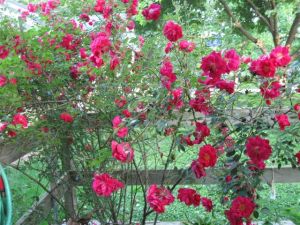
I planted these roses years ago because they reminded me of the climbing roses my grandaddy grew on the fence surrounding his vegetable garden in Georgetown.

Amazing how fast a three-day weekend can go. Yesterday was warm and sunny and breezy. I spent a fair amount of time writing and waiting for my son Matt to come online, which he did around 3:00, but he has not been talkative lately. One of his friends last week stepped on an IED in Kandahar province, where they have been deployed for the last year, and got both his legs blown off. His name is Gregg, but I don’t know any more about him, how close he was to Matt, what his rank is, what job he was assigned, where he is from, where he is now, whether he is married or has children, whether Matt was nearby when it happened, or anything else. Matt said to ask him in a year how he’s doing; right now he doesn’t want to talk about it. I hope some day he can talk about all of this or find some other way to deal with it.

His grandfather Ralph, who was at the Battle of the Bulge and also with the troops when they opened up the first Nazi concentration camp, never wanted to talk about his experiences of war. The only hint of what he had seen was a brief poem he wrote once with images of blood on the snow after a battle. I wish he were here now to help Matt through the mindfields of life. There are so many amputees and brain injuries from these most recente wars. It is horrifying. Of course, the soldiers who are featured in gee whiz news stories are those who fight to walk again, with the aid of fancy new spring-loaded prostethics, and who go right back into the war zones to demonstrate, I suppose, how brave soldiers can be, leaving the others, who are justifiably bitter and angry about their injuries, feeling like lesser men, weaklings, when they can’t just buck up and carry on. On this Memorial Day, I am thinking of those who have died in war, along with their friends and families who have suffered such tragic loss. I am praying that some day we humans can find a better way than war to solve conflicts.

I got a little bit of work done in the garden this weekend, but I need to finish up. The main thing on my list is to find places for the new plants I bought recently—eight new perennials and about the same number of annuals (tomatoes, basil, lantana). I deadheaded the daisies and pulled up some of the chives around the mail box, until the ants came pouring out of the ground carrying their eggs everywhere. I also pulled out the asters that were growing over the surprise lilies, but I need to decide how many asters to leave and then cut those back, so they won’t get so out of control this year.

Apparently, you can cut asters back until July without affecting the fall bloom. I’m not sure which of the asters has spread the most. I have three kinds out there—one that blooms in September, one in October, and one in November. Maybe this year I can pay attention to which ones have replanted themselves all over the yard. I also need to figure out how many of the blackeyed Susans I want to leave. They really took off last summer and have almost filled the circular space in the center of the yard, which I used to call the butterfly garden, when it had more variety of plants. I picked some more brocolli and strawberries. Even though I am nowhere close to self-sufficient, it makes me feel good to grow at least some of my own food.

My roses are looking amazing this year. I have never had this many buds and blossoms. Always before the deer have bitten them off just as they were about to bloom. I’m not complaining, but the deer have been scarce this year. A couple neighbors even planted hostas right out in the open, and those are still looking lush and green. We have seen a couple deer in the back woods, but they have not (so far, at least) been a problem in the front yard. Maybe I’ll actually get to grow tomatoes for a change!

It’s been a strange spring in other ways. While cleaning out the gardens, we have found literally hundreds of acorns and dozens of small oak trees sprouting. I don’t know if the trees had a bumper crop last year, or if the squirrels forgot where they buried their stash, or if the snow covered the ground for so long that animals that normally forage for acorns (like deer, perhaps?) could not get to them, or what, but I don’t remember ever having to pull out so many oak trees. Fortunately, the spring has been wet, so the trees have not been too difficult to pull out. The yard next door has a forest growing in the front. The neighbors moved out some time ago, but there has been no for-sale sign and apparently no one maintaining the house and yard.

It’s been about a week since people started talking about the cicadas emerging from the ground where they have been lying dormant for thirteen years. The last time these red-eyed cicadas were around, Isaac and I were at scout camp in Arkansas. In fact, that year (1998) was the first time since 1777 that both the 13-year and the 17-year cicadas were out at the same time. It was certainly loud enough, especially when you added the annual cicadas to the chorus. (or perhaps I’m remembering the 400 screeching boy scouts!) From what I’ve been reading, the periodical cicadas generally emerge in May and stay above ground through June. After they emerge from the ground, their shells harden and they move up into the trees, where the males congregate to “sing.” After mating, the females cut slits in small branches and lay their eggs. When the caterpillars emerge, they return to their underground burrows for another thirteen years. What a life! Apparently, they do little damage to mature trees, so I don’t need to worry about anything, with the possible exception of my lemon tree, which I should probably cover with cheesecloth. If I liked to fish, I could use them for bait. Here’s more about the periodical cicadas.

We went out to the bee yard again last evening to put on the new supers Jim has made. They look so beautiful, with their fresh white paint, and the new frames with foundation all ready for the bees to draw out creamy white comb. I love the smell of the fresh wax foundations. I suppose the new plastic foundation they have been selling lately is more convenient than having to wire the frames for the wax foundation, but I don’t like the plastic, and we have had trouble getting the bees to draw out comb on the few plastic frames we have tried. We looked briefly in all the hives but did not see the queens in any of them. They all had good patterns of brood, though, with eggs and larva in all stages of development, including plenty of capped brood, so we think the queens are doing well.

One hive, though, has had numerous queen cells for about six weeks, so we’re not sure what they are doing, but it seems to be distracting them from collecting honey, even though there is plenty of clover in the fields right now. We think that hive swarmed earlier in the summer, and they appear to have a queen, who is laying eggs, but they also have several capped queen cells and a couple queen cells with larva and royal jelly. Not sure what’s going on in there, but they did not need one of our beautiful new supers. The new hives (the swarm hive and the split hive) are doing well and seem calmer. The hive we have dubbed the “mortgage lifter” is collecting honey like mad, so we have not looked very far into their hive lately, since they seem to be thriving. The old angry hive, which may have swarmed and which we also then split, is still somewhat defensive. When Jim was checking them, the bees kept bumping against his hands in warning but did not sting. I stayed back aways while he worked that particular hive, with my hands in my pockets, just in case.

After we left the bee yard, we went to Coopers Landing for beer and Thai food, but we had to park about a mile out and walk on the MKT trail to get there, because the road was covered with water. Some people ignored the signs and just drove on the trail to the landing. We had a very pleasant walk along the river and stopped to take a couple photos of the high water. The landing was crowded with people, and we had to stand in a long line in the camp store to get our beer and then in another long line to order our Thai food from the trailer out back, but everyone was in a festive mood. Every picnic table was filled with people; some had brought their own lawn chairs. A band was playing rock and roll, people were hula-hooping, boats were running up and down the river, children were riding bikes around the trails; the colorful umbrellas over the picnic tables were fluttering in the breeze.

After we ordered our food, we joined our friends Krishna and Eric at a table up above the loading dock and talked about plans for the upcoming Cumberland Dance Week, which we are all attending in July. Several men in a fishing boat motored by; one man stood up in the middle of the boat and raised up a huge catfish to show off. People at the landing cheered, and the boat circled and then headed up the river. By the time we finished our food and headed back down the trail to the truck, it was dark. Lightning bugs were flashing and the frogs were singing as the river rolled on.

Dancing in the Village of Elsah

Farley's Music Hall, Elsah, Illinois (photo courtesy of Historic Elsah Foundation)

Saturday night we went to the most charming dance I have attended in a long, long time. The dance was held at Farley’s Music Hall in the village of Elsah, Illinois, to celebrate the recent graduation of four members of the Young family, including our friend Valerie, who just earned her degree in math and women’s studies from the University of Missouri. By the time we arrived, it was just getting dark, and electric candles shone from the windows of several historic buildings in the little village. As we drove down the street, we could hear music coming from the hall.

We entered the hall through a small foyer. To the left of the foyer was a small woodstove, framed photos of the graduates on the wall, and a table holding large coolers of iced tea and lemonade. To the right was another table with cake, chocolate-covered strawberries, and wraps that we would eat later during the break. Through the wide doorway, we could see a gleaming wooden floor, with two lines of dancers of all ages on either side of the center support posts, a few spectators sitting on chairs around the hall, the caller Eric Schreiber standing at a microphone at the far end of the hall, and members of The Bony Goat Band (on fiddle, banjo, guitar) sitting in chairs at the far end of the small hall, playing without amplification. We recognized several dancers we know from St. Louis, who seemed pleased to see us. Valerie’s mother also seemed pleased and surprised that we had made the two-and a-half-hour drive.The hall felt so warm and friendly, just the way I imagined such a place would be when this country was new, and villagers would routinely gather at old-time dances in grange halls on Saturday nights.

I am always pleased to discover communities that are dedicated to preserving the character of a place the way that Elsah has, even in the face of great tragedies such as the 1993 flood, which put the village of Elsah to a test as they made the difficult decision to rebuild. The Farley Dance Hall was originally built in 1885 and served for many years as “a center of village activity, including visits from wandering Indian medicine shows, meetings of the literary clubs, church socials, school plays, and all sorts of dances.” In the early twentieth century, the Knights of Pythias purchased the building and added on a second floor.

After the flood of 1993, the Historic Elsah Foundation purchased the building, and with grants from the National Trust for Historic Preservation and the Illinois Historic Preservation Agency, stabilized the building and brought it back to life. In the process, they revealed the original interior paint, with charming stenciled designs in blue, maroon, and white, under the layers of newer yellow paint. They decided to leave the original milk-based paint on the upper walls and re-painted the wainscotting and trim to match. If you’re ever out for a drive through southern Illinois along the mighty Mississippi, I highly recommend a visit to the village of Elsah.

Organic Food: Safer, Friendlier, Better?

This is the title of Chapter 2 in a great little book we picked up from our local public library called How the Government Got in Your Backyard: Superweeds, Frankenfoods, Lawn Wars, and the (Nonpartisan) Truth About Environmental Policies. I told myself I was not going to get into politics in my blog, but truth is, I think about politics a lot and am fascinated by power struggles and wild differences of opinion. I also happen to subscribe to the belief that the personal is political, so there you go. After spending a week with my dad recently and wondering every minute how we could have ended up so far apart politically while at the same time holding such basic core values in common (e.g., independence, self-governance, fiscal responsibility, stewardship, and an abiding appreciation for “nature”), I especially appreciate this book for its head-on, scientific, nonpartisan approach to some of the biggest environmental issues we face.

The authors are Jeff Gillman, an associate professor in the Department of Horticultural Science at the University of Minnesota, and Eric Heberlig, an associate professor of political science at the University of North Carolina Charlotte. They do an excellent job presenting the complexities surrounding key environmental issues; each chapter focuses on a single issue—organic food, pesticides, fertilizers, alternative energy, genetic engineering, plant patents, invasive plants, legal and illegal plants, local restrictions, global warming—all issues I am deeply interested in but do not know enough about. Each chapter includes essential scientific information about the issue, relevant governmental policies and policy options, ratings from left-wing and right-wing perspectives, plus the “bottom line.” The introductory sections also provide a clear overview of how science and political science interact, as the authors compare the contradictory roles of various players (politicians, scientists, lobbyists, the public), making it abundantly clear why it is so hard to get at the truth of these issues—not least because “politics is about making value judgments,” while “value judgments are outside the realm of science.” So policymakers are left having to decide what outcomes are desirable and at what cost, without the benefit of “hard science” to guide them, because science, which can be contested or modified with future study, does not offer The Truth, but often raises more questions. Add in the conflicting pressures from the public and the lobbyists, with their often narrowly defined self interests, and it is very difficult to know what is the right thing to do.

As I read the chapter on organic food, I found myself thinking in new ways about where I stand on the continuum between increased government regulations and letting producers do what they need to do to raise crops. Where the environment is concerned, I generally weigh in on the side of increased government regulations for the protection of people and the Earth, while my dad generally weighs in on the side of free market and entrepreneurs.  I generally distrust businesses that have profit as their primary motivation, while dad thinks bureaucrats put too many limits on business owners who need flexibility to respond to the market. We both mistrust large corporations, but I lean toward increased regulation to try to protect consumers, while he recommends lowering their taxes and getting the government off their backs so they could be more competitive in giving consumers what they want.

But I can see how the lines could get blurry. For example, I don’t want the city or the neighborhood association to tell me I can’t grow native perennials or vegetables in my front yard but must have a perfectly manicured and weed free (i.e., chemically treated) lawn, so in that instance I would be anti-regulation, I suppose.  As a gardener who tries to raise plants “as organically as possible” but who sometimes reaches for pesticides or fertilizers to solve particular problems, I can appreciate on a small scale how challenging it is to find a balance between philosophical ideals and practical applications. But I definitely want the label to tell me what is in that bottle of spray so I can make an informed decision before I use it. Even if the ingredients are labelled “natural” or “organic,” I prefer to know about any potential dangers they might pose to honeybees or other beneficial insects before I spray my grape vines. I also know that I am one of the lucky ones who can afford to pay a little more for organic and locally produced food, a luxury that many, many people do not have in today’s economy. Given all that, is it right to mandate numerous regulations that increase the overall cost of production and impose undue burdens on small producers, when we have no guarantee that organic methods are superior to conventional methods, or to restrict the ability of large producers to produce foods in the most cost-efficient ways possible?

The authors do a very good job of raising some of the questions that I generally avoid thinking about too deeply. For example, I happen to believe that growing organically is better for our health and better for our planet,  but is it then preferable to buy from a large-scale organic farm, even if they must use nonrenewable fossil fuels to ship their produce to my town, or is it better to buy from a small local farm, even if the farmer occasionally uses pesticides and fertilizers? If a local milk or meat producer avoids the use of hormones, treats her animals humanely, allows them plenty of time outside to graze, and does not put animal waste products or other questionable ingredients in their feed, but does occasionally treat them with antibiotics when they get sick, should the farm lose its credentialing as an organic producer? If a farmer returns from the weekly market with bushels of unsold turnips and lettuce and other produce, should he be allowed to feed it to his pigs at the end of the day, knowing it will go to waste before next Saturday’s market? Or should the state, in an attempt to protect people’s health, be allowed to define the unsold turnips as “garbage” and thus outlaw feeding it to animals that will be sold for meat? These are important but difficult questions that we all weigh in on every time we put food to mouth.

The day the rapture was predicted but did not come

The garden in May

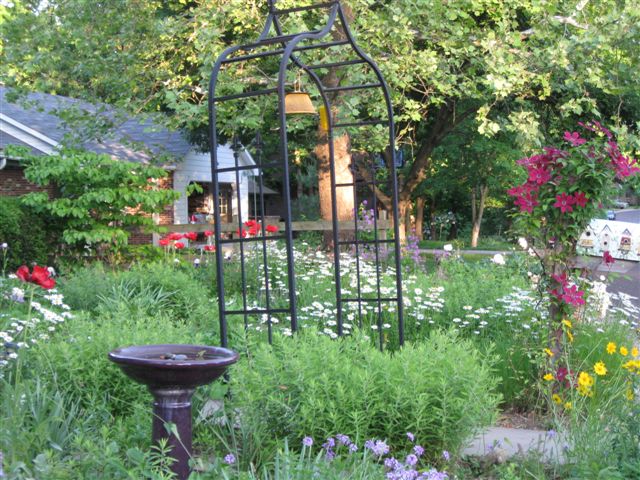
Although the meteorologists predicted 80% chance of rain and the doomsday prophets predicted the rapture would occur on May 21, in my corner of the world today, things were as perfect as they could be, and I spent my day happily poking about my gardens. Here are some of the things I did:

  • Inspected the grapes for the brown Japanese beetle larva I had seen earlier this week and picked those off. Pulled weeds around the base of the trellis. Dug out a few more asters and coneflowers to share with my office mates. Looked at the dried, shriveled, and skeletal leaves and debated whether I should spray the grapes again. Noticed that the new leaves coming on are very healthy and green, although many of the older ones are looking poorly. I don’t know if the worms caused all the damage or if perhaps the grapes also have some sort of disease. The “Garden Safe” spray I have is supposed to be a fungicide, insecticide, and miticide. Apparently grapes have a lot of problems. But even though the spray is billed as “Garden Safe,” it comes with warnings not to inhale, not to get on your skin or use in food-handling areas or when bees are foraging, which makes me doubt the safety of this product. The instructions also say not to apply to wilted or otherwise stressed plants; instead they recommend a 7- or 14-day preventive spraying schedule in spring and fall. The ingredients on the spray list .9% Neem oil and 99.1% “other ingredients.” Hmmmm. I decided to forego the spray for now and focus on building up the plant’s strength, so after picking off all the larva I could find, I added composted manure and fed each vine with an organic dry fertilizer, Plantone.
  • Inspected the rose for green sawfly larva but could not find any more (I had found two the day before and picked those off). I did find something that might be either a stink bug or a soldier bug, plus a small cluster of metallic eggs. I need to figure out which bug it is, because a stink bug is a pest (especially damaging to soybeans), while a soldier bug is a beneficial predator. Until I can figure it out or see some signs of damage on the rose, I just pulled off the leaf that had the eggs, took it around back to the deck, photographed it, and watched the adult bug fly off before I had a chance to inspect its belly and legs for identifying characteristics. I also weeded around the rose and added composted manure and fertilizer. I photographed the rose bush because it looks better than it has ever looked before. I’m not sure why the deer have not been a problem this year, but I’m grateful.
  • Added composted manure to the pot with the lemon plant and pruned one branch. The leaves are looking greener since I added calcium, Epsom salt, and fertilizer about a week ago.
  • Weeded along the sidewalk leading from the driveway to the front porch, cutting enough daisies to fill my two ceramic “paper-bag” vases that I got from the J Peterman Company years ago. Cut back daisies that were fading or were hanging too far over the sidewalk.
  • Pulled out dozens more oak and maple trees that were coming up all over the yard. Noticed how much leaf litter I still need to rake up from the corners of the gardens up near the house and under the yellowing daffodil leaves. Jim cut down a walnut that had grown taller than the lilac and was crowding the butterfly bush. He also dug out some wild grape vines that were suffocating the hollyhock and threatening to crowd out the peas growing on the small trellices.
  • Removed the cages from the square-foot gardens, where the brocolli is looking amazing! Took more photographs. Pulled weeds. Added a little composted manure around each plant. Later Jim harvested enough brocolli for a small serving each at dinner. It was delicious. It’s so amazing to watch plants grow from such tiny seeds into something so beautiful and nourishing. We have seen no signs of the dreaded cabbage caterpillar this year, although there was some other green worm that had chewed holes in a few of the leaves. I took photos of that to have as a reference to look up later on the internet, but I got distracted holding the leaf in the sun and watching the changing patterns of shadows and sun as the leaf turned in the breeze. It reminded me of watching a solar eclipse once through a pin hole with my back to the sun, when the light went all shimmery and there were shadowy half moons all over the sidewalk. I forgot all about the worms for a moment and was fascinated by the appearance of the bright yellow marigold through one of the worm holes—on the day when the rapture was predicted but did not come.
  • Jim ran the weed eater around what few grassy areas have not been taken up by perennial beds or vegetables.
  • Inspected the various gardens and tried to figure out what to do next. I’m liking my approach this year of staking out places for small 4 x 4 pocket gardens. For one thing, it makes it easier to decide what is weed and what is valued perennial. If any coneflowers or asters or shasta daisies or blackeyed Susans or chives or lambs ear or poppy mallow or lemon balm or any of the other self-seeding, aggressively spreading plants I have all over my yard encroach on the 4 x 4 space that I have designated as my new pocket garden and do not fit the new “plan,” then I either pull each plant out as a weed or dig it up and take it to work to share with my gardening friends. So far I have made two of these little gardens, both along the sidewalk leading from the driveway to the front porch. In one, I planted seven varieties of lavendar and edged them with purple and yellow violas. By having all the lavendar in one place, I’m hoping I will remember to mulch them so they have a better chance of surviving our cold winters. In the other I planted three rhubarb plants and edged that with alyssum. While weeding that space yesterday, I discovered a couple volunteer cilantro plants and one dill and decided to leave them, since they are annuals and won’t get in the way of the rhubarb this year. It will make the “plan” less obvious when the dill begins to tower over the other plants in an awkward way, but that will be temporary as it will quickly go to seed and be done.
  • While trying to figure out where to put my next pocket garden, I discovered a cute little poppy mallow with delicate fringed leaves that was struggling to survive under the marjoram and lambs ears, so I “weeded” around it to give it more air.
  • Looked in mild dismay at the asters taking over the space by the mailbox and inching toward the strawberry patch, plus individual asters coming up in farflung places. I need to figure out what to do about those. They are not difficult to pull out by the roots at this point, but I don’t know how well they transplant. When I pull them out and put them in pots for my friends, they immediately begin to wilt, but I suspect they make a strong comeback once planted in the ground. I am fairly sure that asters I have yanked out by the roots and tossed on a pile have on more than one occasion crawled off to replant themselves before I could get them on the mulch pile. I have heard that if you cut asters back severely in the spring (to 3-4 inches), they will grow back at a slower pace through the rest of the season. That sounds right. Perhaps I should give that a try. I have seen asters neatly trimmed in small mounds, and they look beautiful in the fall. I might try both approaches. For sure, I want to pull out the ones that are covering the surprise lilies that will bloom in August, but I want to be sure to keep some of all three varieties of asters. I love them for their late color, as they bloom right after frost and continue sending up their little blue stars from September to November, providing a last source of nectar for the bees to get through the winter.
  • I weeded the patch of new iris that I planted near the road, but I don’t expect them to bloom this year because I was late getting them in the ground last fall. I may go ahead and plant some annual seeds there—cosmos, probably, or zinnias—because that’s what my old neighbor used to plant when his iris were done. My other iris (the purple and white ones that I got from our first next-door neighbors here, ones she had gotten from an estate somewhere) have inched away from their original location and are now closer to the front sidewalk and in and among the strawberries and columbine. Only one has bloomed so far.
  • Pondered the situation with the strawberries. We have had about eight strawberries so far, with more coming on. They were delicious with my yogurt and blueberries and granola parfait. I have never done much with strawberries other than let them grow. Perhaps I should feed them or cover them with netting or mulch them. Wonder why they call them strawberries. Should I be putting straw under the plants now to keep the berries off the ground, or should I cover the plants with straw over the winter?
  • Weeded the areas around the trellises and tried to guide the pea vines up the trellis but did not tie them yet. I’m not sure if I got the seeds in the ground early enough this year, but they are looking good so far. I also have a new native clematis that my friend Krishna gave me, and it is starting to take off. I hope it is in a sunny enough area.
  • Started thinking about where to plant the eight new perennials I got from the Missouri Wildflowers stand at the market: two varieties of liatris, larkspur, wild ginger, blue sage, royal catchfly, queen of the prairie, and Indian physic. Some of these I have tried before with no success, so I need to make sure I understand their preferences for light and shade, wet and dry, before I put them in the ground.
  • Admired my handiwork and gave thanks for such a beautiful day on God’s green Earth.