Or I should say, why is there still a dead parrot in my freezer? I originally put it there myself one winter day over a year ago (or maybe it’s been two years by now). Our furnace had gone off while we were at work and we came home to a shivering, sniffling little gray-cheeked parrot, with his feathers all puffed out and his eyes runny. He looked miserable, and I felt bad for him but didn’t know what to do for him besides turn up the heat. But it was already too late. Soon after, he stopped eating, and a few days later I found him dead on the bottom of the cage, where he had fallen from his perch. I intended to bury him in the spring when the ground thawed. In the meantime I wrapped him in newspaper and put him in the freezer. But to my chagrin, he’s still there, and I obviously can’t use the excuse that it’s been too cold or I haven’t had time to bury the poor little thing in all that time.
His name was Spike, and he belonged to my son Isaac, who had bought him with birthday money and allowance money when he was about eight years old. He was mostly green (a deep emerald green on his backs and wings, lime green on his belly), with gray cheeks, and a spot of orange under his wings. He was a small parrot, slightly bigger than a parakeet, and much louder. He was a sociable little bird but never quite learned to talk, although he often made little screechy sounds that mimicked our inflection, and he got very excited and much louder when people were trying to have a conversation. Whenever we played Latin music on the CD, he would bob his head and dance back and forth on his perch. Other music didn’t affect him the same way; we wondered if he were responding to some genetic memory. Occasionally, we let him out of his cage to fly around the house, but he mostly wanted to sit on our heads, which got annoying. He was about fifteen years old; if he hadn’t gotten sick, he might have lived another ten years. As it was, he had already outlived all Isaac’s other pets. At one point his room was so full of small pets (the parrot, two finches, two parakeets, two hamsters, a rat, an African frog of some sort, two snakes, a tortoise, a lizard, a box turtle, several goldfish, and a beta) that Isaac decided it was too noisy in there and moved to a different bedroom downstairs.
I have to admit this isn’t the first time I have had something strange in my freezer. My young sons routinely used the freezer in their pretend play. More than once, while rummaging around for fish sticks or frozen corn for dinner, I would come across miniature “freezing chambers,” with Hans Solo or Princess Leia encased in ice. One year Matt tried to save his snow balls for another day. Both he and his brother used the freezer and refrigerator to conduct numerous “scientific” experiments during elementary school. And for years, I could expect to find frozen mice in various stages of development (pinkies and fuzzies) as feed for Isaac’s snakes. And of course, the parrot wasn’t the only small pet to die during the winter. But this is the longest I have ever held such a thing in my freezer. It doesn’t take a genius, probably, to figure out that Spike’s death marked the end of an era that I was reluctant to let go. Although at the time I complained incessantly about the noise and the mess and the many projects, I loved having my boys at home, and I miss them terribly.
I wish I knew more about physics. At the very least, I would like to understand something about the time-space continuum. Perhaps that would help explain how a single summer day in childhood can go on forever, but as one gets older, whole years seem to disappear between breakfast and dinner; decades pass between dinner and bedtime. When I think about time, I am reminded of my in-laws, who, when asked the time, would always respond, “by the clock?” The usual answer in their family was “yes, by the clock,” at which point further clarification would be required to determine which clock—the kitchen clock, which always ran ten minutes fast, or the clock in the den, which was usually five minutes slow, or some other clock in the house? I don’t remember people consulting their watches in these instances, but I suppose that was possible. Occasionally, people would respond, “no, not by the clock,” which meant the other person would do the math for you and give you the actual time. Of course, that assumed that the clock had not gained or lost additional minutes since the last time anyone checked. This was in the days before cellphones and computers and microwaves and every other kind of household gadget had clocks synced to satellites, so one could never be completely sure that the time you were given was accurate, whether “by the clock” or not. I always wondered why my in-laws didn’t just set all the clocks to the same time, rather than go through this complicated ritual. I didn’t realize then how slippery time was and how difficult to keep track of, with or without clocks.
I have since noticed that this ritual may not be as uncommon as I at first thought. Other people, including myself, go through a similar routine when they change time zones while travelling or when they “spring forward” in March or “fall back” in October. Some people, like my stepfather, will reset their clocks immediately upon crossing into a new time zone and seem to have no trouble with the concept of “gaining” or “losing” an hour. They never concern themselves with what time it “used to be.” They live completely in the present, and they always tell time “by the clock.” Other people seem to have trouble letting go of the “old time” and may refuse to change their watches when going on short trips or crossing only one time zone. Even those who do change their clocks and watches to the “new time” may for a while feel the need to calculate what time it is in the place they recently left or what time it “used to be” before someone decided we should save daylight. Although I don’t wear a watch (or perhaps because of that), I tend to obsess a bit about different time zones and am continually doing the math in my head, adding an hour when I think about my mother or my brother, subtracting an hour when I think about my grandchildren, subtracting two hours when I think about my daughter-in-law, trying to picture what each of my loved ones is doing at that time in that place. I also love checking the World Sunlight Map to see which places in the world are just waking up and which ones are shrouded in darkness. And yet it worries me not at all if the clocks in my house are a few minutes fast or slow, or if they are all set to different times.
This summer I became painfully aware of the tricks that time plays and of how time can contract and expand simultaneously. In July, while my younger son, Isaac, was on his honeymoon in Peru, my older son, Matt, was preparing to deploy to Afghanistan with the Fourth Infantry. I wanted the days to go slowly so Matt would not have to leave; and I wanted the same days to go quickly so Isaac would return home soon. Now, three months later, Isaac is at McMurdo Station in Antarctica with a team of scientists, while Matt is at a checkpoint in Kandahar province, with a platoon of soldiers and their Afghan counterparts. I am still in “central time,” continually calculating what hour it is where they are. When it is noon today in Missouri “by the clock,” it is 9:30 tonight in Kandahar and 6:00 tomorrow morning at McMurdo, where it is spring and the wind chill is 4 degrees F today. All of this completely boggles my mind. On those days when I am lucky enough to be able to chat online with Matt or receive a phone call from Isaac, I can’t help but marvel at how my sons are able to talk to me “from the future.”
After hearing that some of the soldiers who deployed to Afghanistan last summer with the Fourth Infantry, some for the third and fourth time, had not received any mail after nearly two months at war, I decided to “adopt” my son’s platoon. Of course, I realize that this means that in addition to worrying about my son’s personal safety, I now have twenty more young men to fret over. But that is the least I can do. It is not right that I am able to sit in the comfort and safety of my own home night after night, while these brave young men sacrifice so much. (I realize that many of the soldiers fighting and dying these days are women, but my son’s unit is still an all-male unit.)
I know very little about what they have been asked to do, but I know they have few comforts and must work long hours with little sleep in the part of the country that has come to be known as “the volatile south.” They are not far from the Arghandab valley, where several men from their sister platoon were killed shortly after arriving in country. Fort Carson, home of the Fourth Infantry, has lost seventeen soldiers in Afghanistan this year and sixty-one in the country since the war started, including three scouts killed last week. My son acknowledges that “it’s hard,” but they carry on “by sheer will and brotherhood.” What choice do they have?
My plan is to send each of the privates and specialists in the platoon at least one care package per month until they all come home next July. And I pray they all do make it home physically safe and mentally sound. When I first mentioned my idea at work, I was surprised at the number of people who wanted to help. Several of my coworkers said that they had been meaning to do something like this ever since the wars started, but they didn’t know how. A few years ago, people could send care packages to “any soldier,” but that program was discontinued because of fears for the security of the troops. Now, unless you know the name and APO address of a specific soldier, it is hard to know how to help. And unless you go searching for news about the wars, it is difficult to find out what is happening. Gone are the days when the major campaigns made headline news. In fact, plans to embed journalists were recently canceled for the second time in as many weeks, so news is hard to come by. The best source I have found is icasualties.org, which I check religiously several times a day, but I know that even with the wealth of information available online, I am only able to access a tiny fraction of the truth about what these wars are costing everyone involved.
I can’t help but think that if we at home had to suffer more—if the draft were reinstated or if gasoline and coffee were rationed, for example—we would pay more attention to what is happening and would demand a resolution to the conflicts. It is too easy for many of us to distance ourselves from these wars, a position that was not possible when the draft was in effect and anyone with a son or brother or husband or father had a personal stake in any conflict or potential conflict. At least in previous wars, people “on the home front” were more likely to knit socks and bandages or raise Victory gardens or buy war bonds or make other sacrifices that, if nothing else, served to keep the war in the public eye. Even during the Vietnam War, lists of local soldiers and their APO addresses used to appear in the newspapers, so people from the community could send cards and letters, especially around the holidays. The year I was fourteen, I copied down a long list of names and addresses and sent Christmas cards to soldiers, using money I had made from babysitting to pay for postage. I didn’t know much about the war, but I could easily imagine how hard it would be to be fighting for your life so far from home and how much worse it would be to think you had been forgotten.
Tonight I will finish packing up the last of twenty boxes to send to one small platoon currently fighting far from home, in Kandahar, Afghanistan. I very much appreciate all the people who have donated materials and personal notes to place in these packages, as well as cash to help with postage. I hope these care packages bring some measure of comfort to the soldiers. My son assures me they are much appreciated. I told him I wish I could do more for his platoon and for all the soldiers and civilians caught in these endless wars. I mentioned something about how people used to knit socks for the soldiers, and he said, “Oh, please, don’t!”
The “paperless revolution” we hoped for when computers first made their appearance certainly has not come to fruition. Apparently digitizing everything only made it that much easier to print multiple copies of everything. It seems as though I spend half my free time sorting through papers of all kinds, trying to figure out what to keep and what to throw away, and then feeling overwhelmed by all the papers I’ve held onto over the years, and guilty for the boxes and bags full that I’ve sent to the landfills and recycling centers. (Maybe I had the right idea, after all, the summer before college when I threw all my juvenile journals into a wire bin and set fire to them.)
It would be difficult enough if I only had to go through the papers I have collected myself over the years—journals and notebooks, poetry manuscripts, old calendars, school papers, scrapbooks and photo albums, postcards and letters, my children’s drawings, clippings of garden designs, brochures I’ve picked up along the way, maps of places I’ve been, address books, tax forms, insurance policies, old checkbook registers, and on and on. But in addition to all that, every day except Sunday the postman brings another pile of paper for me to deal with. Ironically, today in my email, I received an invitation to register for a three-day workshop in Montreal for “professional organizers.” (Don’t even get me started on email clutter!)
Some weeks I try to go through the mail as soon as it arrives, but usually after a day or two of that, I get overwhelmed and just let all the bills, the fliers offering package deals on cable and Internet services, and those pleas for worthy causes pile up again. And then there are the magazines I don’t have time to read and the catalogs of things I can’t afford or don’t want. I admit I ordered some of these myself, deliberately inviting the clutter into my home, but I did not ask for the businesses to share my name and address with other businesses that think they might somehow talk me into buying even more magazines and ordering from more catalogs. But sometimes I fall for it, despite my better judgment. Just this week I accepted the offer of a free magazine called Yes!, which is printed on 100% post-consumer waste paper by some nonprofit organization called the positive futures network or some such. Seemed like a good idea at the time.
I should just go ahead and buy one of those monster shredders like my son, the ex-CID agent, uses—the kind that will shred an entire envelope full of fake credit cards, CDs, card stock, and multiple pieces of paper. But my shredder only takes six thin pieces of paper at a time (and that grudgingly), so I always open every single envelope and sort the contents. The bits that have my personal information on them I shred, and the rest I recycle. Lately I have even begun taking the time to tear my address off the backs of catalogs before recycling the rest, although I know my address is not in any way private information and could easily go into the black plastic garbage bags that I put out on the curb each Wednesday.
Opening each envelope the way I do, and being a print junky as I am, means I tend to read all those “personalized” letters from environmental and political organizations, urging me to take action, quickly, before it’s too late, so in addition to feeling guilty for the sheer waste of all this paper, I also feel guilty for not responding to the pleas to help such worthy causes. These marketers know that if they can get me to focus on just one individual prisoner of conscience or one oil-covered bird or one wolf pup about to be shot from a low-flying helicopter or one cancer victim or one child suffering from cleft palate or orphaned by the latest natural disaster, I am more likely to write that check.
And yet, it’s not paper in general that I object to. It’s the cheapness of certain paper, the slimy, gritty feel of the sales ads; the garish colors of the catalogs; the invasive type screaming at me to sign up for cable for only $59.95 a month for life, although I do not own a television. But good paper is something entirely different. I love fine stationery, quality drawing paper, watercolor paper, well-made journals, clever scrapbook paper, heavy textured hand-made paper with deckled edges, marbled end papers, brightly colored tissue paper, delicate origami paper, clean new notebooks with unbroken covers. I value the paper for itself—the look and feel of it—but also for the promise it holds of beautiful drawings or insightful writings. I think about stories I have heard of people living under repressive regimes around the world, who dared to write in tiny script on precious scraps of paper.
Recently, my son, who is in Afghanistan with the Fourth Infantry, told me that the only thing the children in his village have asked for has been paper and pens. I can imagine how they must feel, to have something important to say but no place to record it. Even though I had plenty of paper and crayons and markers as a child, having been raised in a family of college professors, I loved getting new school supplies each year. Something about those clean notebooks and new pencils made it seem that anything was possible. I also remember when a shiny piece of white shirt board was a treasure, and I would take my time before deciding how to use it because it might be awhile before I got another one just like it. So when my son told me about the children wanting something to write on, I immediately went out and bought thirty composition books and sixty pens and packaged them up to send across the sea. I only wish I might have a chance someday to read what the children write.
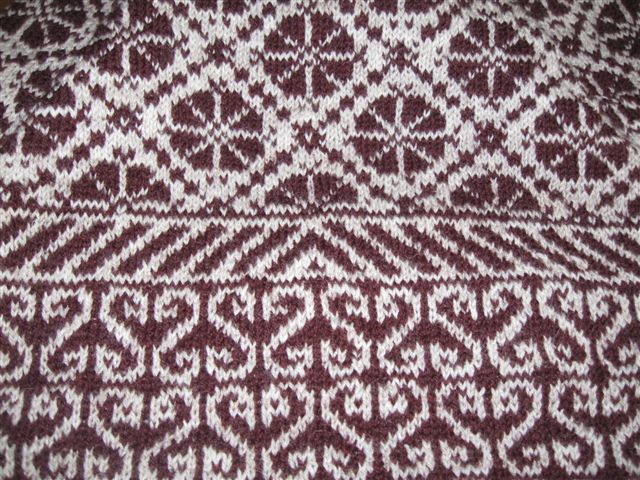
Now that the evenings are getting cooler, I am ready to get back to work on a sweater I started knitting last December. This is the most complicated pattern I have ever knit, but I am very happy with the way it is turning out so far. It is a two-color Shetland pattern; the yarn is fingering weight wool, and the colors are plumberry and ash.
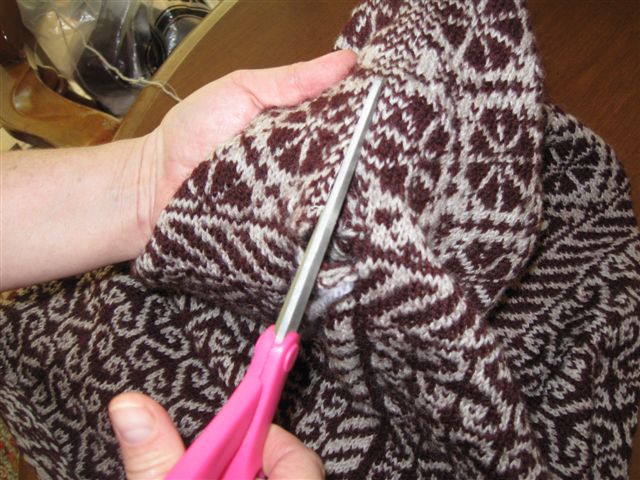
Unfortunately, I am now at the point where I must cut the steek or abandon the project. My friend Amber, who has already made a sweater by this same pattern, assures me I can do it, and several helpful articles online indicate that there is little risk of unraveling a sweater with a steek cut. But the idea of cutting through a tube of knitting that took so long to make is completely counterintuitive, and so far, I have resisted taking a pair of scissors to my work. The woman at the shop where I bought the yarn was no help, either. When I told her about this pattern, she said, “On, no! That’s too scary! I would never do that.” Not much of a sales pitch, I must say.
Nevertheless, I can see the advantages of steeking, especially for Fair Isle sweaters and other complicated patterns. With the steek, you knit the sweater in the round, with the right side facing, which allows you to follow the intricate pattern more easily. Having a steek means you don’t have to knit the sweater in sections (back, front, sleeves) and then sew them together, because you knit the entire sweater in one piece. Amber says that once I’ve mastered steeking, I will never again want to sew in sleeves. The steek itself is a kind of bridge of approximately six extra stitches knit in a tweed-like pattern to reduce the chance that it might ravel after being cut.
At this point, the sweater is a tube with a steek on each side where the sleeves will go. I have already basted down the center of each steek and run a machine stitch along both sides of the basting and across the bottom and top. The time has come to cut the steeks along the basting, so I can pick up the stitches around each opening and knit the sleeves into my sweater. There is another steek along the front neck, which I don’t completely understand, but I hope its purpose will become clear eventually.
Several people have been following the progress of my sweater since last December, including my aunt Juanita, my mother-in-law Ruth, and several women from the dance group in Lawrence, Kansas, who watched me struggle when I first started work on the sweater. I spent most of the first weekend casting on the 125 stitches, knitting a few rounds, discovering that I had twisted the stitches and was unknowingly knitting a Möbius sweater, and then taking the stitches back out. After I finally got the stitches cast on and then knit enough rounds to convince myself that the stitches were not twisted again, I went through several rounds of knitting and un-knitting the border pattern. Until I was able to see the pattern emerge, I kept losing track of where I was on the chart. But eventually, I got into the rhythm of the pattern. After that, each time I returned for a visit with my aunt or my mother-in-law or attended another dance in Lawrence, people would ask to see my sweater and comment on how much progress I had made.
The last time I worked on the sweater, however, was on a long drive to visit my mother over Memorial Day weekend. At that point, I had done all I could do until I got brave enough to take my scissors to the steeks. My excuse was that it was way too hot to sit with a pile of wool in my lap and knit in the summer. And I would almost have believed that excuse myself, except for the fact that I then proceeded to knit an alpaca wool scarf in the meantime. But now that there is a slight chill in the air some evenings, I’m reminded how much I would love to be able to slip my arms into the sleeves of this beautiful sweater come winter time. So here goes.
Cutting the steek
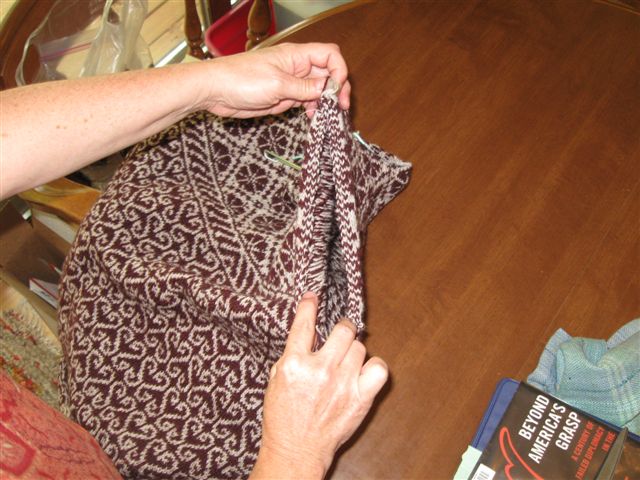
After the steek is cut, it's time to pick up stitches around the opening and begin knitting the sleeve.
We just returned from an English/American dance weekend in St. Louis, happy but tired after 13+ hours of dancing. The weekend was sponsored by Childgrove Country Dancers, and it certainly lived up to the promise of “Contra the way English dancers like it, with spit and polish and interesting music, and English the way Contra dancers like it—full of energy and joyous spontaneity.” I have been a contra dancer for almost thirty years and a square dancer for longer than that, but I must say that this was the first time I actually enjoyed English Country Dance. I have been to ECD workshops and dances before, but I have not had fun at those—partly because I didn’t know what I was doing, so I felt silly and awkward, and partly because the group didn’t know what they were doing, so the events plodded along, with more teaching than dancing, and little joy or spontaneity. I also had trouble getting into the “high tea” spirit of English country, being more of a “whiskey” kind of person myself by nature. But this past weekend, there were enough people who actually enjoy English Country Dance and are strong enough dancers to guide beginners like me through the figures with a fair amount of grace. For the first time, figures such as “turn single” made a little more sense, and I could begin to imagine how they might flow into the next figure in a meaningful way. In addition, the caller, Joanna Reiner, efficiently taught each dance, called just enough to get us started, and then stopped calling so we could enjoy the gorgeous music. On Saturday night, when many of the dancers arrived in period costume for the “ball,” I felt as though I had stepped into an eighteenth-century novel, and I found myself wondering whether we wouldn’t be better people if we paid more attention to our appearance and to ballroom manners in all our daily interactions.
The dance weekend was held at the wonderful Monday Club in Webster Groves. The Club began informally as a reading circle founded by five women who got together on Mondays, when their housekeepers had the day off. Over the years other women joined, and in 1887, the Monday Club was formally organized. Ten years later it became a charter member of the Missouri Federation of Women’s Clubs. The clubhouse, on the corner of Maple and Cedar Avenues, was dedicated in 1911. A two-story wing was added to the original building in 1929, with a kitchen, dining room, and board room, which made it possible for the members to hold luncheons, exhibits, and teas. At one time, the Monday Club served as a library, and club members assisted the paid librarian two days a week; these days, according to its brochure, the club provides a variety of community outreach programs, educational programs, and senior citizen activities, and it hosts concerts, dinner theatre, fashion shows, public art exhibits, and weekly educational lectures.
We are very fortunate to be able to participate in traditional dances in this elegant historical building. The dances are held in the original auditorium, where there is a small stage, hardwood floor, and built-in bookshelves with glass doors, from the earlier days when the building served as a library. The walls are painted a delicate peach, with white-painted woodwork. Windows line the side walls and look out over stately houses and yards in the well-established neighborhood. Elegant statues and vases are placed throughout the building, and artwork hangs on the walls in the dining room, where the registration table was set up for the dance weekend and where we had our after-dance parties. The women’s restroom has a floral hand-painted sign on the door that says “powder room.” The men’s restroom was apparently added later and is located in the basement. For the weekend, the organizers had strung fairy lights from the rafters in the auditorium and hung British flags and early American flags around the hall.
The weekend started out with a contra dance on Friday night, called by my husband Jim Thaxter, with an after-party that went until 1:00 a.m. We took the group up on their offer of “home hospitality,” and stayed with a wonderful woman named Robin and her family, who graciously opened their home to us for the weekend. Music was provided at all the dances and workshops throughout the weekend by Martha Edwards and Pamela Carson Stoll playing fiddle, with Kendall Rogers on keyboard and percussion. After the Friday contra dance and the after-party and a short night’s sleep, our host fed us breakfast on Saturday morning, and then we headed back to the Monday Club for a morning workshop led by the English dance caller, Joanna Reimer and another workshop in the afternoon. Joanna’s teaching was superb, and I especially liked the way she handled the perennial problem of dancers wanting to socialize while the caller is teaching a new dance. She began by reminding us that she was not the only one responsible for how well the dance went, that each dancer also played an important role, as did the musicians, of course. Then she taught a dance and walked us through the moves a couple of times. After that, before the music began, she instructed the dancers to “remind each other how the dance goes.” I had never seen a caller do that before, but it was a wonderful way to focus the dancers’ attention before the two-beat introduction that signifies that the dance is beginning. We had a four-hour break during the early evening, to give the dancers plenty of time to nap, have dinner, and dress for the ball. By 8:00, the dancers had arrived back at the Monday Club, many of them dressed in Regency attire or other periods of their choosing. In consideration of the small size of the hall, they thankfully did not wear hoop skirts or carry swords. Midway through the evening, at the break, a team of Morris dancers came jingling in and executed a lively choreographed figure in the center of the hall.
Sunday afternoon we had the pleasure of dancing outside near the fountains at the Grand Basin, at the site of the 1904 World’s Fair, on a clear blue fall day, while the sun was shining and the wind was blowing. Various callers took turns leading the dances, and Kendall played his accordion along with CDs by Stringdancer, until he became concerned about the amount of dust blowing into the keys. While we danced contras and a couple squares and waltzes, people in paddle boats cruised around the basin. When it was time to leave, we dangled our feet in the cool water before we headed out. Then Sunday evening, we returned to the Monday Club, where we were joined by the regular contra dance crowd for a lively dance, ending the weekend on a high note indeed.
You can tell it’s fall because what used to be a five-minute commute from home to campus now takes twenty to thirty minutes, since 31,000 University students descended on our fair city. These days if you arrive at the office past 7:45 a.m., you must park on the roof of the garage because all the spaces on the first four levels are taken. If you decide later to take a walk during your morning break, you must make your way through crowds of sorority pledges who stroll four abreast on the sidewalks, wearing their look-alike dresses and non-sensible shoes. And you must dodge the students who careen along the sidewalks on their bicycles, as well as the slow-moving students who text while walking between classes. At lunch time, when you go to meet your friends at Shakespeare’s Pizza, expect to spend most of the hour standing in line waiting for veggie pizza slices to come out of the oven. On the plus side, most of the construction on the steam tunnel that runs underground between the power plant and the hospital has moved on past central campus, so the roads and sidewalks are no longer blocked off as hard-hat areas, and the dump trucks have stopped rumbling past our building.The campus landscape services have replaced the sod between the law school and the alumni building and are making plans for new perennial beds. The gospel choir could be heard singing a capella from the speakers circle the other day, and a man wearing a gorilla suit was playing accordion outside the library. Ah, fall!
Of course, there are other, more conventional signs of fall, as well, such as the yellowing leaves and hard green walnuts raining down on our driveway, the perennials gone to seed in the garden and the flashing goldfinches feasting among them, the bee hives filled with capped honey. And lately when we sit down to our dinner of fresh local vegetables, we wonder what we will find to eat when winter comes. We are already mourning the absence of peaches and cantaloupes and new potatoes, the dwindling supply of green beans and corn on the cob, even as we enjoy vine-ripened tomatoes, peppers, and zucchini and start to look forward to crisp apples and pumpkin pie.
Some people might think I wasted my summer, because I did not go swimming or boating or camping or backpacking, and I bicycled very little. I also did not keep up with the gardens as I had hoped or spend near enough time outdoors or take a real vacation. Mostly I went to work in an office every day and then spent the too-short evenings doing nothing in particular. But this was still a very good summer. For the first time in years I got caught up in the kind of summer reading I used to enjoy so much when I was a child, when I had all the time in the world and could read anything I wanted just for the fun of it, lying on a blanket in the back yard in the sun or curled up in the green branches of a tree, carried away on adventures that took me far from my ordinary life. I also got reacquainted with my local public library, which is a lively place if there ever was one. Over the summer, I read everything I could get my hands on—from good old-fashioned novels with morally upstanding characters and unbelievably happy endings to contemporary action thrillers filled with sex and violence of the most depraved variety. As though I were back in the Busy Bee Summer Reading Club, I read many different kinds of books: real-life adventure, mystery, action thriller, historical novel, romance, spiritual biography, war memoir, science, history. I read old favorites and recent best sellers. I enjoyed them all.
When I was not reading, I poked through family photos and old letters and reminisced about my grandparents. I started a heritage scrapbook, which felt exactly like playing paper dolls when I was a kid. Sitting on the floor for hours with piles of colorful paper, scissors, bits of ribbon, and glue brought back many happy memories. I also continued my yoga practice this summer, with sessions on campus two or three times a week. We watched a couple good movies at Ragtag, our local independent theater, including Winter’s Bones and Cyrus. We went to a few old-time square dances in a small town nearby; attended an Irish concert by our friends Helen Gubbins and Tim Langan; saw the Carolina Chocolate Drops at a street concert outside the Blue Note downtown; played a little piano and banjo; had friends over for dinner; went blueberry picking; and kept watch over a pair of wrens, who nested in the space above our front window, until the babies fledged. We went to the farmers market regularly: the large one on Saturday morning and the smaller ones on Monday and Thursday afternoons.
Earlier in the summer when the Missouri River was exceptionally high, we started a new tradition, which is sure to become a favorite in years to come: nearly every time we drive out of town to check on the bees, we stop at Coopers Landing on the way back to watch the river go by, enjoy a beer and some Thai food, listen to music, visit with friends, and watch the sun set over the water. Once when the river was over the road and we couldn’t make it to the landing, we saw a hawk walking awkwardly along the side of the road stretching its wings, taking awkward little hops but not flying even when we drove up right next to it. At first we thought it had been injured and were trying to figure out how to call the raptor rehabilitation group at the University, until we heard a larger hawk screeching encouragement or warning from the tree above the road and realized this must be a juvenile hawk we were watching.
The high point of the summer was my younger son’s wedding, which took place at Stephens Lake on June 26 and brought friends and family from far away to celebrate. (More about this later.) The low point was when my older son deployed on July 19 for a year in Afghanistan. (More about this later, as well.)
Summer Reading List
A Short History of Nearly Everything by Bill Bryson
Anthologist: A Novel by Nicholson Baker
Borderline by Anna Pigeon
Freckles by Gene Stratton Porter
Girl of the Limberlost by Gene Stratton Porter
Girl with the Dragon Tattoo by Stieg Larson
Kaboom by Matthew Gallagher
Keeper of the Bees by Gene Stratton-Porter
Kentuckians by Janice Holt Giles
La’s Orchestra Saves the World by Alexander McCall Smith
Little Shepherd of Kingdom Come by John Fox
Morality for Beautiful Girls (No. 1 Ladies Detective Agency, Book 3)
Tea Time for the Traditionally Built by Alexander McCall Smith
The Double Comfort Safari Club by Alexander McCall Smith
Winter Study by Anna Pigeon
Wolf at Twilight: An Indian Elder’s Journal Through a Land of Ghosts and Shadows by Kent Nerburn
Worst Journey in the World by Apsley Cherry-Garrard
I am currently reading Twilight at the World of Tomorrow: Genius, Madness, Murder, and the 1939 World’s Fair on the Brink of War by James Mauro.
We have promised ourselves a vacation in mid-October.
I love the way some children will dress up for a school dance, as though they were going to a ball or a costume party. Little boys may wear their Sunday best, little girls may wear sparkly red shoes with their favorite pink sweatpants or shiny silver dresses, either gender may wear their Halloween costumes. Last night after work, my husband Jim called another school dance, this one at West Boulevard elementary school. You never know what to expect from these dances, but they are always entertaining.
The first time I went to a school dance with Jim was for a “Fall Festival,” where what seemed like 200 children, many of whom were dressed up as cowboys and cowgirls, were running around the gymnasium while parents sat in folding chairs around the edge and teachers tried to impose some order. There were long tables of snacks set up at the back of the gym opposite the stage, so throughout the evening, the children would break formation and run back to grab a cookie, or they would announce (just as the dance was starting) that they needed to go to the bathroom and leave their partner standing there. From the looks of things, it appeared that more than a few parents had dropped their children off at the school and then gone elsewhere.
At one point during the evening, Jim was patiently lining children up again and teaching the next dance, although it was hard to tell if anyone was listening, because of all the extra noise and activity in the gym. After a few minutes, he turned to the band and announced that the dancers were ready to go. The look on their faces was priceless, as they mirrored what I had been thinking: “You have got to be kidding!” But Jim repeated that they were ready for some music, and sure enough, once the music started, the children reformed their lines and started moving in time to the music, skipping and bouncing and clapping to the beat, and having a very good time of it.
We have attended many children’s and family dances since then, including the “Snow Ball” at the public library, a dance for the Girl Scouts during summer camp, another camp dance for special needs children, graduation dances for home schools, wedding dances, birthday dances, church dances, and lots of dances for elementary schools. Over the years, Jim has developed quite a large repertoire of dances and has also learned to trust that the children are paying more attention than we might think. Still, every dance presents its own challenges.
At the “Snow Ball” last winter, for example, the average age of the children was about three years, and all were in costume: lots of fairy princesses, a few super heroes, and one fire fighter. Jim immediately threw out all of his dances that depended on knowing your right from your left or separating from your partner. He has also had to adjust his definition of “couple” over the years, to allow for “couples” consisting of a father holding the two-year old and a mother carrying the baby in a sling while holding the four-year-old by the hand. Since that first “Fall Festival,” now when Jim makes arrangements for school dances, he always requests that the organizers encourage parents to dance with their children and save the snacks for later.
It takes a special band to play for these dances, and Nine Mile is one of our favorites (our friends John White on fiddle, David Cavins on guitar, Amber Gaddy on accordian, and Jim Ruth on banjo). Jim often starts by calling a big circle dance to teach the basic moves (do-si-do, right-hand turn, left-hand turn, forward and back, and so on), but when we arrived at the school last night, we found out that the dance had been advertised as a “line dance.” Not knowing exactly what the children or teachers expected but knowing we weren’t going to be doing the “boot scoot” anytime during the evening, Jim decided to save the circle dance for later and start with a longways set. However, it seemed to take longer than usual to line everyone up, at least in part because the gymnasium (which was carpeted) had prominent lines marked out for various sports, and the children kept lining up on those; this made for some very nice straight lines but put the children too far from their partners for dancing. The children caught on quickly, however, and formed two sets of double lines, with each dancer standing across from a partner.
With each new dance, Jim first taught the moves without music, then walked the dancers through a time or two, and then asked the band to start playing. At first the children were tentative, but after they realized that they could do everything he was asking of them and that it was all just for fun, they began to enjoy themselves. The longways sets were all variations of a few basic moves—do-si-do your partner, top couple dance down the middle and come back up, top dancers separate and lead your lines to the bottom, form an arch, lines come up through the arch and back to the top, then start over—new top couple do-si-do your partner, dance down to the bottom, and so on. Toward the end of the evening, Jim called a circle dance and then led them in a figure called “wind the ball” that always makes dancers laugh, as he dropped hands with his neighbor, warned everyone else “don’t let go, whatever you do,” and then led the long line into an inward spiral and then back out. It can be dizzying when you pass the other dancers on your way back out of the spiral.
After the dance ended and the band was putting away their instruments, I walked around the gym and tried to remember what my own school gymnasium looked like, but all I could remember was a fallout shelter sign in the stairwell and Lassie one time visiting our school.
The walls at West Boulevard are made of large concrete blocks, with the top half painted sky blue and the bottom half painted tan. One wall is filled with windows that opened out to a rainy sky. The stage is obviously used for storage as well as for assemblies. In addition to the state and national flags, a podium, microphones, and sound system, there were racks of chairs, a towering pile of mats, ladders, dust mops, folding tables, cardboard boxes and Rubbermaid containers, plastic garbage cans filled with soccer balls, a notebook of physical activities, and another notebook labeled “Walking School Bus.”
The walls were filled with signs and posters: letters of the alphabet with words about sports or exercise (A for archery, B for basketball, C for catcher, D for dance); the school pledge (“I am safe, I try hard, I achieve, I am respectful, I am responsible—I am a STARR”); a chart with stickers next to children’s names; a poster shaped like a big yellow star with children’s names written in various colors of magic marker; a poster of the Food Pyramid; a white board with a reminder to “wash, wash, wash your hands.”
There were also many, many instructions about the proper way to line up, complete with rules about “lining up on your P.E. Number” and photos of good lines, which showed children and teachers facing forward, keeping their hands to themselves and their feet still, standing quietly ready to leave the gym, and it suddenly made perfect sense why they had at first had trouble with Jim’s instructions to “line up for a dance.” The lines for dancing were totally different from the lines they had been practicing at school. When I saw the “P.E. Numbers” marked with masking tape on one of the lines near the exit, I was even more impressed at the children’s flexibility in learning something so far removed from their experiences and the skillful way they navigated between all these conflicting rules imposed by parents, teachers, and guests.
Someday in the future, when these children grow up, I hope they will look back on this evening, when old and young, black and brown and white, came together on a rainy Friday night, and had fun listening to traditional American fiddle tunes and dancing the way people have been dancing for hundreds of years. Perhaps at some point, some of them will pick up an instrument or seek out an old-time square dance or contra dance, ensuring that the traditions don’t die out.
Every spring for the past nineteen years, usually on the first weekend of April, people from all around gather in Boonville, Missouri, for the Big Muddy Folk Festival, organized by Dave Para and Cathy Barton. The format generally consists of a full evening of concerts on Friday and Saturday evening, a dance following the concerts on Friday, workshops during the day on Saturday, and barbeque throughout the weekend.
The performances are held in the historic Thespian Hall, beginning around 7:00 p.m. and ending around 11:30 p.m. Between acts, Masters of Ceremony Dave Para and Meredith Ludwig entertain the audience, make announcements, and thank volunteers and sponsors, while the stage hands set up microphones and monitors for the next set. This is the only concert series I know of with an intermission long enough that people have time to wander across the street to Turner Hall to partake of barbeque or purchase CDs and books, or handmade dulcimers, rag rugs, wooden toys, or silver jewelry. This year you could also purchase raffle tickets for a colorful afghan (which were not, as Dave Para explained, “despite what you may have read in previous communications,” one dollar per ticket or four tickets for five dollars, but were actually six tickets for five dollars.
I missed the early years of the festival, but in the past twelve years, I have had the privilege of hearing many fine performers play a wide variety of roots music: old-time string music; Appalachian ballads; Missouri fiddle tunes; Irish fiddle tunes; Cajun; Texas swing; ragtime; minstrel tunes; blues; German polkas; klezmer music; straight-up folk songs both traditional and contemporary; gospel; some Carter family songs; and what you would probably have to call variety acts (one year an eighty-year-old woman played the fiddle while holding it on top of her head; another time a man from the conservation department made bird calls). These kinds of acts have become less common at the festival over the years, but Dave will still occasionally do an ironic performance in which he plays a serious and wide-ranging tune such as Autumn Leaves, while an equally accomplished and funny musician will accompany him on piano, with exaggerated arpeggios and dramatic pauses between phrases. The audience always gets a kick out of this.
Often there is dancing as well as music. For the past few years, Cathy and Dave have invited a small group from the Mid-Missouri Traditional Dancers to come on stage and dance an old-time square at the beginning of their set; this year they also invited us to come back on stage at the end of their set to dance a waltz and do a little clogging. The audience seems to enjoy watching us dance, even if they don’t join us later at the open dance at Turner Hall after the concert.
Many of the tunes and songs have a river theme, as you might have guessed from the name of the festival. In addition to growing up along the Missouri River, Cathy and Dave spent seventeen summers on the Mississippi River, playing music on the Delta Queen riverboat. Consequently, many of the songs and tunes they have collected and written over the years are about life on the river. Frogs and turtles and water birds often appear in the designs for the backdrop at Thespian Hall and for festival t-shirts. Behind the small stage at Turner Hall where the musicians play for the Friday night dance is a painting of a riverscape.
Another equally strong theme of the festival is loss: loss of a way of living, loss of place, and loss of friends and family who have passed on, including Cathy and Dave’s dear friend Bob Dyer, who was a big part of this festival from the beginning and who also wrote and performed many songs and stories about the river. Often I find myself weeping during the performances, when I think about all who have gone ahead or hear about people or places I wish I had known: an old woman named Hazel whose belongings are up for auction, a fiddler who lost his fingers in a logging accident, or the residents of a town named Ellenton, SC, which was taken over by the government for the purpose of producing materials for the H-bomb. This year both themes were particularly strong, because the Delta Queen riverboat has recently been put in dry dock due to financial problems, and Cathy and Dave and many others are mourning the loss of a grand tradition. The large ceramic frog that serves as the festival mascot these days crouched stage left throughout the festival, sporting Bob Dyer’s straw hat.
The spirit and basic format of the festival has not changed much over the years, as far as I can tell, although the schedule has been tightened up a bit and the performances don’t tend to run over as often as they used to. Also, I think there may be fewer acts each night and fewer surprise appearances by performers not listed on the program, so each individual or group gets to perform longer. In recent years, there have been four or five performers scheduled each evening. I believe there may have been more workshops this year, but unfortunately I was not able to attend during the day on Saturday. By the time we arrived for barbeque before the evening performance, a group of musicians was jamming on the front porch of Turner Hall, making me wonder what a good time I had missed.
I like it when different parts of my life converge, even in small ways. Since spring finally arrived, I have, of course, been busy in the gardens and the beeyard, and I’ve let the house go. (If you are curious what I’ve been doing in the gardens, check out my other blog, What’s the Buzz.) But one cool and cloudy day I decided to pick up where I’d left off with my decluttering project, and I found to my delight that the next shelf of books contains mostly garden books. It was like reconnecting with old friends. Most of the books were published in the 1990s, but a few were published in the mid 1970s. These I remember having had when I first left home and was trying to grow my own vegetable gardens.
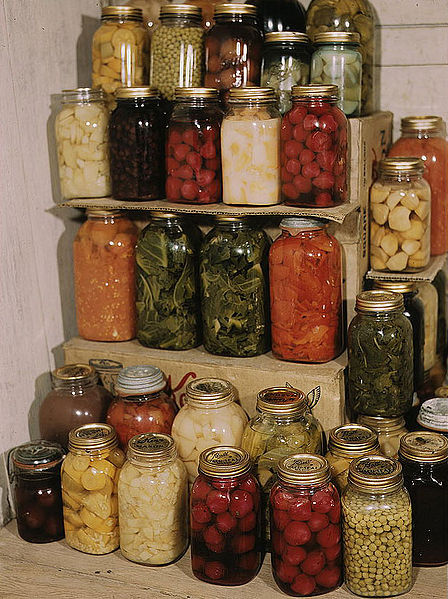
One year, not long after graduating from college, we rented a large garden plot—about 25 x 50 feet, as I recall—where I grew tomatoes, green beans, corn, cucumbers, watermelons, and squash, space-hungry plants I couldn’t grow at the apartment where we lived. That first garden must have been fairly successful, because about that time I also bought a pressure canner and other canning supplies. I vaguely remember feelings of pride as I looked at a pantry shelf filled with colorful jars of tomatoes, bread and butter pickles, and green beans.
I liked canning vegetables because it reminded me of my paternal grandmother, who lived in the foothills of Appalachia and who regularly put up hundreds of jars of green beans and tomatoes in the summertime. Even when she lived in town and ran a restaurant or worked at her husband’s grocery store, she would still put up vegetables, buying them fresh at the farmers market during the summer and canning them for the winter. Gardening makes me feel connected with something important, a whole way of living that could too easily be lost if we don’t pay attention. My maternal grandfather was also an avid gardener, who taught economics during the school year and then had his summers off to garden. When I go back to my hometown these days and look at the parking lot that once held his house and gardens and fruit trees, not to mention my swing set and sand box, the space seems unbelievably small compared to the lush gardens I remember once occupied this land.
On this shelf of garden books, there is a noticeable absence of books published during the 1980s, the years when I was raising young children and going to graduate school and teaching part-time. During those years, the best I could do was plant a few bulbs in front of the porch in the fall and then, after the tulips had bloomed and faded, sow cosmos or zinnia seeds in the same place, which would bloom until frost. We did rent a community garden space through the city parks department for a couple of years during that time, and my sons got to share my amazement at how such small seeds can grow into such large plants, and I got to tell them a few stories about their great grandparents, but the community plots did not have a ready source of water, the summers were often hot and dry, and the swings and slides at the nearby playground beckoned.
You could probably guess by the number of gardening books from the 1990s that we bought our house in 1989. Although it was not the small farm I dreamed of owning someday, I finally had a piece of land where I could grow something besides annuals and a few bulbs. Still, a traditional single-row vegetable garden was out of the question, as the back yard was wooded and the front yard was partly shaded by a Bradford pear and the neighbor’s huge sycamore tree. Furthermore, the soil was typical construction fill and heavy clay, with little topsoil. I decided to start by growing native perennials and herbs, especially those that do well in poor to average soil and don’t need constant pampering, as my children were still young.
The books collected from this time period include general gardening reference books that covered everything from designing your garden to planting and maintaining to solving common problems. Some of these reference books are arranged topically, some alphabetically, and some by seasons. There are several books focusing specifically on herbs; of these my favorite is The Country Diary Herbal by Sarah Hollis, which includes delicate watercolor illustrations that remind me of old botanical books and paintings.
Not having given up completely on my dream of someday owning a larger piece of property, I also have a book on solar gardening and one called Country Life: A Handbook for Realists and Dreamers by Paul Heiney, published by DK, which has numerous photos on home farming and includes sections on fencing, farm machinery, animal husbandry, orchards, harvesting, and processing foods. The shelf also holds several books on native landscaping. These books show how to use nature’s designs to plan your yard, and they are typically organized by growing conditions (e.g., the sunny garden, the dry sunny garden, the moist sunny garden, the shady garden) or by regions (e.g., Eastern woodland, alpine desert, California native garden) or by themes (e.g., Japanese stroll garden, bird and butterfly garden, scent garden). Some include charts that show what month each plant blooms; others include charts arranged by color of bloom. They almost always address ways to attract wildlife to the garden (meaning, apparently, birds and butterflies, not groundhogs and deer) and sometimes draw a connection between gardening and spirituality, as is most apparent in Cultivating Sacred Space: Gardening for the Soul by Elizabeth Murray.
But the books that really capture my imagination are literary reflections on gardening, two of which I rediscovered on my shelf. One is called Second Nature by Michael Pollan, which I had been meaning to reread, especially for what he has to say in his chapter “Weeds Are Us.” The other is An Island Garden, which is a reproduction of a book first published in 1894, illustrated with Impressionist paintings by Childe Hassam. The cloth binding is decorated with gold leaf in the Art Nouveau style that was common in the late nineteenth century, and the text brings back the joy and wonder I felt as a child wandering through my grandfather’s vegetable patch or picking flowers from his cutting beds or climbing up into the fruit trees to read. The author of this book, which I bought many years ago, is Celia Thaxter. Who knew I would eventually meet and marry a man named Thaxter? Perhaps someday we will make a trip to see her island garden ourselves.


 His name was Spike, and he belonged to my son Isaac, who had bought him with birthday money and allowance money when he was about eight years old. He was mostly green (a deep emerald green on his backs and wings, lime green on his belly), with gray cheeks, and a spot of orange under his wings. He was a small parrot, slightly bigger than a parakeet, and much louder. He was a sociable little bird but never quite learned to talk, although he often made little screechy sounds that mimicked our inflection, and he got very excited and much louder when people were trying to have a conversation. Whenever we played Latin music on the CD, he would bob his head and dance back and forth on his perch. Other music didn’t affect him the same way; we wondered if he were responding to some genetic memory. Occasionally, we let him out of his cage to fly around the house, but he mostly wanted to sit on our heads, which got annoying. He was about fifteen years old; if he hadn’t gotten sick, he might have lived another ten years. As it was, he had already outlived all Isaac’s other pets. At one point his room was so full of small pets (the parrot, two finches, two parakeets, two hamsters, a rat, an African frog of some sort, two snakes, a tortoise, a lizard, a box turtle, several goldfish, and a beta) that Isaac decided it was too noisy in there and moved to a different bedroom downstairs.






 Reality Bites