Unknown's avatar

About Marcie

Writer and Editor

Button Boxes

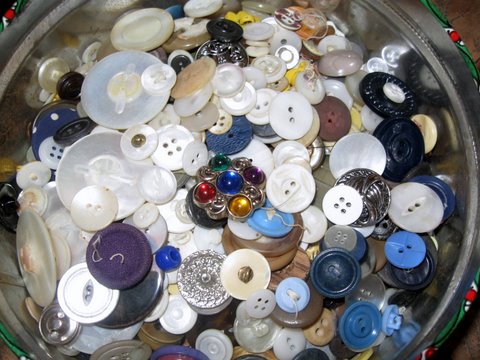
This week I have been digging through my button boxes, trying to find six matching buttons for a sweater vest I knit earlier this winter. What is it about buttons? These are not particularly fine buttons, but I find them interesting. I like the way they feel in my hands, the way the small ones slip through my fingers, the light sound they make when they tumble over each other into the metal box. I like to think of the people whose hands have touched these buttons over the years, as they sewed them onto a garment or pushed them through the button holes to fasten their shirts or jackets.

I don’t remember where I got this particular button box, but I have vague happy memories of playing with such a button box when I was a child. Do people even keep button boxes any more? Used to be women would snip the buttons off old clothes to re-use on another garment and would save any good pieces of fabric to make scrap quilts. At least that’s how I imagine it was, although my maternal grandmother didn’t sew at all and my paternal grandmother always bought new fabric for her quilts. So where did this particular button box come from? I only recognize a few of the buttons from my own sewing projects. Perhaps my mother-in-law, who sewed for other women and always had extra fabric and notions lying around, gave it to me the year I decided to make Christmas stockings for my children. Perhaps I bought some of the pearl buttons at the antique mall for that project.
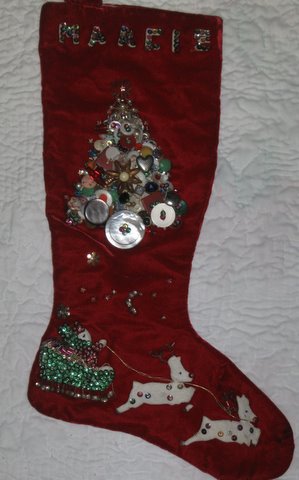
When I was eight, my aunt gave me and my brother beautiful red velvet Christmas stockings, lined with white satin. On the front of each was a large Christmas tree made entirely of antique buttons and sequins. When my brother and I posed in our pajamas with those stockings, holding them out for our parents to admire, beaming at the thought of all the wonderful gifts and candies that Santa would fill them with, they were so long they nearly reached the floor. We used to spend hours examining the buttons on our stockings, turning them this way and that in the colored lights from the Christmas tree, excited when we found we had buttons that matched, even more excited when we found buttons that the other didn’t have, each of us convinced that our stocking was the most beautiful, our buttons the most special.

The buttons in my button box are not nearly as fine. Mostly the box is filled with ordinary plastic buttons, the kind that would have been on dress shirts or wool coats or women’s jackets in the nineteen fifties. A few have embossed floral or geometric designs that I like. There are a couple metal buttons, one large button covered with blue and white polka-dot fabric, buttons shaped like leaves or bees or tiny handprints, many buttons made of pearl, a few buttons with rhinestones. There are no painted buttons or glass buttons. A quick web search tells me that I’m not the only one with a fascination for buttons and that button collecting gained popularity in the 1930s as a hobby that anyone could afford. The National Button Society was formed in 1938 and today has 3,000 members on four continents. There are button shows, including one this spring not too far from where I live. There are competitions and awards, magazines and newsletters. I discover that buttons are classified according to age, use, size, material, and design; and that age and use are specified by division. I learn that there is an online discussion group dedicated to button collecting.

I learn that I don’t know a thing about buttons, that the buttons that I cavalierly grouped together as all made of “plastic” could in fact be made of celluloid, cellulose acetate, casein, phenolic, amino, polyester, acrylic resins, polystyrene, nylon, polyclays, or ABS polymers (none of which mean anything to me). There are ways to test for these, of course, and if I cared enough, I could order a “Synthetic Polymers Handbook” that will give me “more information to aid in my identification efforts and general plastics education.” There are whole booklets filled with rules about how (or whether) to clean antique or vintage buttons, how to assemble a tray or mount your buttons, how to enter  button collections in competitions. Nearly 9,000 sellers are offering buttons for sale today on Ebay. Some buttons are listed individually; some by the pound. I am frankly overwhelmed. Now, instead of bringing me pleasure, my small box of buttons makes me anxious.
Shaker Box

When I was a girl, my mother and brother and I used to drive through the old Shaker village at Pleasant Hill in the summer on the way to visit my grandparents’ lake cabin, before the road was re-routed around the historic village. Even then, in those simpler days of childhood, I was struck by the peace surrounding the village, the stately buildings, the gently rolling hills, the quiet air space overhead.

Years later, the state library where I worked used to hold retreats at Shakertown, thinking, I suppose, that the place was so isolated we would have to face head-on any problems with our co-workers, because there was no place to get away, just a common room stocked with board games and cards. The managers even went so far as to assign roommates who were known to have had conflicts in the past. When we arrived for one of these dreaded retreats, the librarian I was to bunk with immediately began opening the many doors and drawers in the floor-to-ceiling cabinetry and peering under the beds in our room, “looking for bodies,” she said. I never could tell if she was joking or not.

Another memory of Shakertown involves my in-laws, who complained bitterly the whole weekend that there was no television and therefore “nothing to do.” When my husband and I couldn’t stand it any more and decided to go out for a walk after dark, his parents worried out loud about tree limbs blowing down out of the ancient trees and knocking us in the head. Later, after we had returned to the room uninjured, they worried that our two-year-old would fall out of the high poster bed onto the hardwood floor and get a concussion and then how would we ever get him to the hospital, and where was the hospital, even. The pictures from that weekend show my son, wearing a spring green corduroy jacket with a hood, climbing the white rail fence against a painfully blue sky.

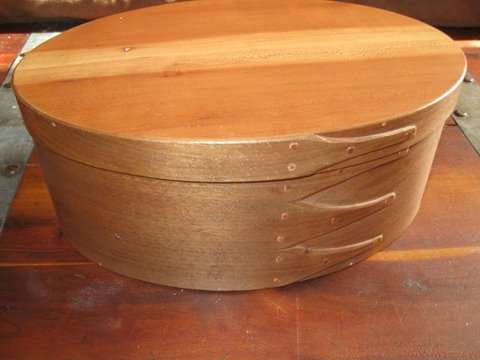
I don’t remember when I got my Shaker box, but I love the smooth oval shape, the fine-grained cedar, the tight-fitting lid. It is medium size, about 3¾” deep x 9½” long x 6½”  across. Although this is the only Shaker box I have, I picture it in the middle of a tower of other oval boxes, in descending sizes, one on top of the other . It is made of a thin piece of sweet-smelling wood that has been bent into shape and is held together by brass tacks where the tapered ends of the wood overlap. On the outside of the box, the end has been trimmed into three points, each point held down by four brass tacks. The lid is constructed like the box itself, an overlapping piece of thin wood, with four brass tacks holding it together; the top has a wide stripe in the grain that is lighter than the rest of the wood and runs the length of the box.

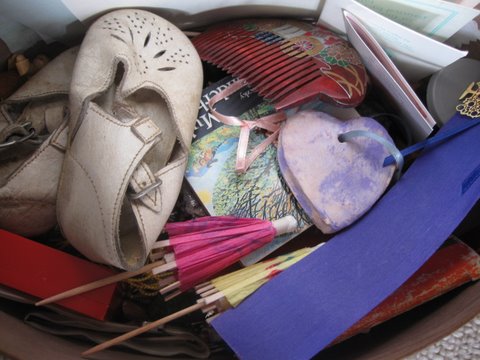
I always loved the simplicity of the Shaker design, the clean lines in their rooms, the lack of clutter, the wooden pegs along the wall for hanging ladder-back chairs. But I never thought about what they would have kept in their drawers and boxes. Something practical, I suspect—sewing goods, perhaps, or garden seeds. Not like the wild assortment of things I found when I opened this box for the first time in many years. The only thing of any real value is an 1890 Morgan silver dollar (which I earned in third grade for writing out the multiplication table faster than anyone else in my class). Most of the other objects have only sentimental value; some don’t even have that, since I can’t remember where they came from, what they were supposed to signify, why I put them in this box in the first place.

And now I don’t know what to do with them all: my baby shoes and a  hospital bracelet made of tiny pink beads and larger white beads strung on a cotton thread, spelling out my maiden name; a silver Tinkerbell charm that I got at Disneyland when I was seven; five tiny umbrellas made of balsa wood spokes covered with tissue paper; an address book with names of friends I had in high school; a miniature clip-on bow tie that my ex-husband might have worn as a child in the early 1950s; my older son’s plastic hospital bracelet from one of the times he broke his arm in preschool; necklaces my sons made for me out of tumbled stones; hand-painted combs and beaded barrettes I bought at art fairs when I wore my hair long and straight; bits of broken jewelry (a sweater clasp, a Wizard of Oz charm bracelet, a dove of peace with inlaid stones, a thin brass chain, a single earring with two interlocking red hearts); a set of “mom’s pins” my younger son earned in boy scouts, attached to a red ribbon; book marks; a miniature book about the seasons, printed in German; Army insignia from my older son’s time in the cavalry; sympathy cards for pets buried in my back yard; a hand-forged nail; a tiny whorled shell; a starfish; a smooth white stone; a buckeye; a blue irridescent “dragon’s tear.

Special Collections

When I took a course in Special Collections in library school, one of our assignments was to take a dusty old box of papers that had been donated to the library at some point and try to make sense of the contents, but we were not to impose our own sense of order. We could open envelopes and flatten the letters inside but could not throw away the envelopes, even those that seemed to contain no important information. We were to remove staples and paperclips, which could rust and damage the paper. We could shake the dust and the dead spiders and the rotted rubberbands out of the folders.

We were to leave the materials in whatever order they were in, based on the assumption that the owner had made conscious decisions before filing them away in this box. We were not to re-arrange anything, either chronologically or alphabetically. We were to catalog each item, assigning it some kind of arbitrary accession number, which would be cross-indexed at a later date with other items in the collection. At the time, I thought we were giving far too much credit to the original owners, believing they had  done more than simply stash things away in the closest box available. I thought about my own boxes of letters and cards, journals, old school papers, photos, receipts, cancelled checks; what a jumble some of them would seem to anyone who might later try to discover their underlying order.

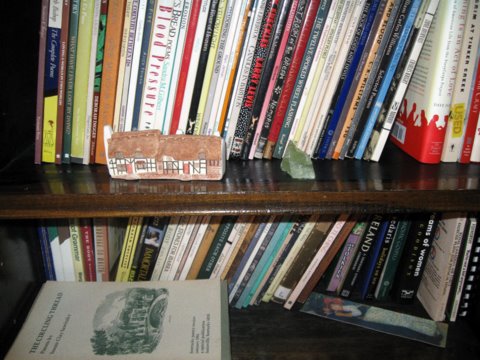
I was reminded of this as I began cataloguing the second shelf of books on the oak bookshelf in my bedroom. I bought the bookshelf at a yard sale in Lexington, Kentucky, when I was in library school in my early twenties. We paid $100 for it, which at the time was a whole lot of money. It seemed very elegant, a shelf worthy of a fine collection of treasured books. It is still one of my favorite pieces of furniture, although it is hidden away in the master bedroom rather than standing in the living room where it possibly belongs. The bookshelf is dark oak, 48” wide and 53” high, with two sets of four shelves. Originally it had two glass doors, which were removed when the glass broke in one of them; the doors are currently in the basement awaiting the day when I can get a new piece of glass cut and locate the hinges (or buy new ones) to re-hang the doors.

Where the first shelf held mostly poetry books, the second shelf held only a few volumes of poetry, along with a wild variety of other books in no apparent order: a book of English grammar; an illustrated “field guide” to Irish fairies; the Tao Te Ching; the Pilgrim of Tinker Creek; a book of essays by David Sedaris; a couple of writing books, including one called The Weekend Novelist; a book of exercises for the Royal Canadian Air Force; several contemporary novels; Alice in Wonderland; a book  by Jeff Foxworthy that my dad gave me when I turned forty called You’re Not a Kid Anymore; a translation of Sir Gawain and The Green Knight by J.R.R. Tolkien; a book and CD from my mom called I Hope You Dance; and The Gnostic Gospels by Elaine Pagels.

After I had entered all the titles and pertinent information into my database, I decided I would impose some order to this mess. I thought I would interfile the poetry volumes from this second shelf with the ones from the first shelf I had catalogued, alphabetically by author’s last name. I planned to do the same with the fiction and nonfiction, as I moved on through the rest of my shelves of books. But as soon as I began to shift the books around to make room for all the poetry books—the first part of the alphabet on the first shelf, the second part of the alphabet on the second shelf—I discovered the obvious organizing principle I had completely missed: The second shelf, it turns out, holds only short books, the ones that will stand straight on a shelf that is less than 8 ½”  inches tall.

Rare Books

Compared to my mother, who taught literature for forty years, and many of my friends and colleagues, who are avid readers and writers, my collection of books is rather paltry. It cannot even be called a proper collection, having neither theme nor organizing principle. Nor do the books on my shelves adequately  represent my reading life, as many of my favorite titles are missing, and some of the books I own I do not care to read.

I have lately begun choosing books mostly by their covers. I limit myself to the new acquisitions shelf at the public library, either nonfiction or fiction, and I choose books that feel right in my hands, books that have simple, well designed covers, and elegant typography; books of just the right size, with pages that fall open in a pleasing way without cracking the spine.

I usually read the blurbs on the back cover and the first paragraph of the book, but those tend to sway me less than the overall look and feel of a book. I have rejected books on interesting topics or by authors I enjoy when the type was too cramped or the inside margins too tight or when the book was too heavy to hold while reading in bed or in the bath.  But I have also discovered wonderful books this way that I might not have found otherwise, including an inspiring book called The Zookeeper’s Wife, about the keepers of the Warsaw Zoo who saved hundreds of people from the Nazis; an extraordinary novel called Let the Great World Spin, which opens with a breathtaking image of a tightrope walker stepping out onto a cable stretched between the World Trade Center towers; and an exhilarating book called Every Living Thing, which presents portraits of individual scientists in their obsessive quest to catalog life.

In my own quest to catalog life, I have decided to start a database of the books I own, and I am finding it surprisingly satisfying to pull each book off the shelf and open it up to locate the pertinent information. Some of these books I have not opened in many years; some of them exhale a musty breath that reminds me of my grandfather’s books that lined the back hallway of the house near the small college where he taught. Some books I remember well; others I have no memory of having read. A few have personalized autographs from the authors, encouraging me to continue with my writing. So far, I have only entered data on about half the books from a single shelf, mostly poetry books accumulated while I was in graduate school. I had not thought of my books as being in any particular order, certainly not by library school standards. What a surprise, then, to find that at least some of them are arranged chronologically, like the record collection in High Fidelity.

As I examine each book (front and back covers, title page, copyright page, CIP information, colophon), I recall many pleasant days spent in the stacks during library school when I studied rare books and bibliography, history of books and printing, and special collections. I especially loved going into the rare books room at the University, where I would sign in and then put on a pair of white gloves to keep the oils from my hands away from the pages, and the curator would bring out a single precious book at a time. In the quiet reading room, I would marvel at the hand-tooled leather or gold-leafed cloth cover, the deckled pages sometimes gilded with gold, the marbled endpapers, the hand-sewn bindings, the thick creamy watermarked paper, the decorated letters; I wondered how many hands had held this same book over the years. I would run my fingers lightly over the pages, like a blind woman reading Braille, and feel the impressions of each letter where it had been pressed into the damp paper.

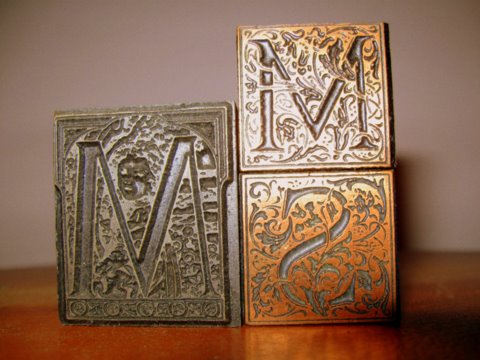
One of the happiest times in my life was during an eight-week course in letterpress printing at the King Library Press at the University of Kentucky. I loved the weight of the composing stick in my hand and the soft click as I set each letter upside down and backwards in the stick, line by line. For my individual project, I printed Dylan Thomas’s Poem in October. The class printed a commemorative chapbook for an upcoming program scheduled at the King Library Press, with each of us setting the type for a single page. We then gathered our individual pages together and laid them in the sewing frame, and the instructor showed us how to sew the signature. The page I set was about oranges at Christmas.

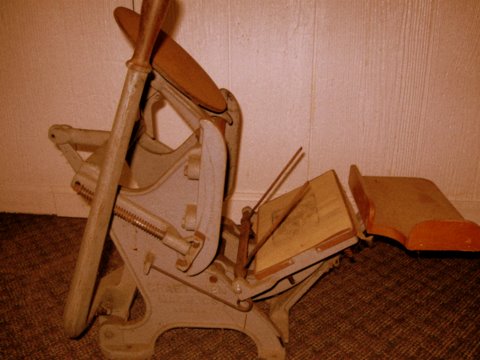
After the course was over, I bought a small printing press somewhere, fully intending to print broadsides and chapbooks and poetry books. I wanted to learn more about the art of bookbinding, printing, calligraphy, papermaking, woodblock prints, engraving. I wanted to try my hand at gold leaf. I wanted to collect beautiful books. I did not want to read mass-produced books like the “yellows” and “bloods” that were printed so cheaply during the nineteenth century, books intended for a new mass reading public, books that people destroyed as they read, by tearing off each page and throwing it away. My advisor, Dr. Robert Cazden, had referred to that period as the “nadir” of printing. If he were still alive today, I wonder what he would have to say about E-books and all they represent. I’m thinking he would not be impressed.

A New Year

I have taken down most of my Christmas decorations and packed the ornaments away under the stairs in a plastic box with a green lid. On the lid is a label made of masking tape on which one of my sons once wrote the words, “Traditional Ornaments” in his confident childscript. It always makes me smile, wondering what the word “traditional” means to an eight-year-old. This year I decided to take the time to sort through everything and only pack away those things that still bring me joy. The rest I may sell on Ebay or give away to friends and family. I had already mailed away two small boxes of ornaments and lights to my sons before Christmas. Both have recently moved into new apartments and do not have money to spend on anything frivolous; I thought they might enjoy some of the ornaments we used to hang on our tree when they lived at home. I hope they found some joy in the objects; it was not my intent to burden them with mere possessions.

When I was young, I enjoyed collecting Christmas ornaments to commemorate travels or special moments of my life, and I looked forward to unwrapping the memories each year when I put up my tree. The year my dad moved out, my mother and I both put up live trees for the first time (one in my bedroom and one in the living room), and I bought several ornaments from an import shop in Lexington, Kentucky, for my very own tree: a wooden crèche inside a walnut half; angels made of tiny pinecones spray-painted gold; a small wooden dwarf with a long beard, a tiny pipe, and wire glasses; and several dozen small golden balls. Each year after that I would add to the collection, but I never wrote down where I got each ornament or what it was supposed to commemorate, thinking I would never forget. The years my first husband and I lived in the antique store on a tree-lined street named Rosemont Gardens, I kept the ornaments out year round, on small ledges that lined the kitchen walls and were intended for displaying decorative plates; I was devastated when our puppy chewed up an entire set of German musicians carved out of native woods, leaving only one tiny violin undamaged.For a while, I looked for a replacement set but never saw another just like it.

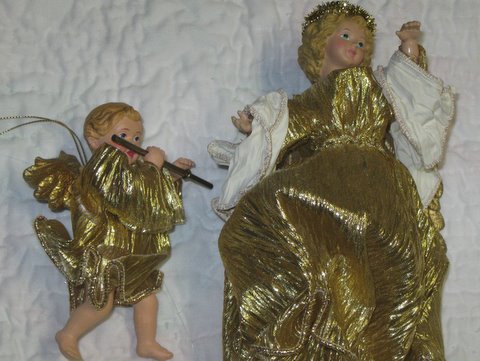
As I sort through the ornaments, it is most difficult to know what to do with the angels, beginning with the littlest baby angel, a wee blond thing cradled in the crest of the moon, acquired the Christmas after our daughter Megan was stillborn one silent day in May. The following year another baby angel decked our tree, this time a red-headed boy sitting on an acrylic cloud, after we lost our son Morgan in October. And every year after, angels continued to arrive in pairs: ceramic baby angels swinging on candy canes, country angels wearing gingham, angels woven out of straw, paper-mâché angels in stiff gowns, batiked angels, angels embroidered with shiny red threads in China, angels molded out of clear plastic, shimmering gold angels, dazzling glass angels. If they had lived, by now Megan would be twenty-six, Morgan twenty-five. When I meet new people and they ask how many children I have, I still pause (wanting to blurt out “four”) before answering, “two: a son who is thirty and a son who is twenty-three,” all the while seeing the shadowy outlines of their siblings in the space between.

Boxes

For as long as I can remember, I have been obsessed by boxes. Perhaps it has something to do with the way we used to move every eighteen months the whole time I was growing up, even after dad got out of the Navy and we didn’t technically have to pack all our belongings in cardboard boxes and move from one place to another all the time. Or maybe my obsession started with the sweet-smelling cedar pencil box my aunt gave me for Christmas the year I learned to write, a hinged box with my name engraved on a brass plate; inside were a dozen pencils with my name printed in gold leaf. Or maybe it goes back to the year I turned fourteen, when we left a basement full of boxes in a house we had rented from the college where my mother worked. My dad fully intended to go back and move all those boxes of belongings before the college bulldozed the house, but somehow he never got around to it. For years I dreamed about those boxes and wondered what we had lost.

I like all kinds of boxes: plain cardboard boxes, wooden cigar boxes, round or octagonal hat boxes, music boxes, velvet-covered ring boxes, heart-shaped candy boxes, nested plastic boxes with pictures of unicorns on the lids, little tin boxes with pictures of fairies, wine boxes with collapsible dividers, acid-free bankers boxes, file boxes with or without handles, oval wooden Shaker boxes, jewelry boxes carved out of stone, Victorian powder boxes with pink powder puffs inside, wooden doll cases with a place to hang the clothes and little drawers for the shoes, plastic storage boxes, button boxes, sewing boxes, rubbermaid containers, heart-shaped wooden boxes, boxes decorated with inlays of native hardwoods.

Over the years I have squirreled away many things in boxes that I would then stash in a closet or behind the books on a shelf or in the back of a drawer or in the garage, to be discovered at some later date and marveled at: bits of colored ribbon, smooth round stones, seashells, paperdolls, old address books, my children’s baby teeth, a lock of hair, a bar of sandalwood soap. I had this idea that I could charge each item with so much meaning that even the smallest pebble could carry the weight of an entire week at the beach that I would never forget. In fact, sometimes I couldn’t remember why I had kept a particular object, but I couldn’t bring myself to throw it away, either, because I knew that at one time, it had meant something to me. Sometimes I would search and search through boxes, trying to find things that weren’t there, wondering how I could have misplaced something important. Other times, I would open a box I had forgotten about and suddenly find myself weeping over its contents.

This year I intend to open each box in my house and see what I can discover about my life: where I’ve been and where I’m going. I intend to examine every item I have accumulated over the years and figure out which ones still serve a need and which ones I can let go.